
How to Choose Reliable Climbing Slings: 2026 Guide
Table of Contents
- What Makes a Climbing Sling Reliable?
- Nylon vs Dyneema Slings: Which Material Wins?
- Climbing Sling Length Guide: From 60cm to 240cm
- Safety Standards and Breaking Strength Explained
- How to Inspect Your Gear for Wear and Tear
- When to Retire Climbing Slings: Key Retirement Criteria
- Final Checks Before You Buy
- Frequently Asked Questions
Last Updated: September 9, 2026
What Makes a Climbing Sling Reliable?
A climbing sling is a sewn loop of webbing used to build anchors, extend protection, and connect gear, and its reliability comes down to three factors: material integrity, certified construction, and honest maintenance. When you trust a piece of nylon or Dyneema with your life on a rock face, the margin for error is measured in millimeters of frayed fiber.
The core of reliability is the bar tack, the reinforced stitching where the webbing is sewn into a loop. A quality sling carries a breaking strength rating in kilonewtons, typically 22 kN for standard models, and that rating is only valid if the stitching is flawless. The sewn loop is the weakest point of any sling, so inspection of that area matters more than the webbing itself.
Nylon vs Dyneema Slings: Which Material Wins?
The choice between nylon and Dyneema slings hinges on a trade-off between durability and weight. Nylon offers superior abrasion resistance, a higher melting point, and better performance under dynamic fall conditions because it stretches more and absorbs energy. Dyneema provides an unmatched weight-to-strength ratio but suffers from a lower melting point and less resistance to sharp edges.
For sport climbing and gym use, many climbers prefer nylon for its toughness and forgiving handling. For alpine climbing and multi-pitch routes where every gram counts, Dyneema's reduced bulk makes it the standard choice despite its fragility. A common mistake is assuming Dyneema is "stronger" in practical terms; it degrades more rapidly from repeated loading and has poorer knot strength retention when tied directly.
The Real Enemy: Environmental Degradation
The true differentiator in long-term reliability is how each fiber responds to environmental stressors.
Ultraviolet (UV) Exposure
UV radiation is the primary culprit in the gradual weakening of all synthetic climbing fibers. The mechanism is photo-oxidation, where UV energy breaks the polymer chains, leading to a loss of tensile strength. For nylon, the degradation is often visible as a chalky, faded appearance or a yellowing of the fabric. For Dyneema, the risk is more insidious: because it is often a bare, non-sheathed fiber, UV light can penetrate and damage the core structure more directly. A Dyneema sling that has spent a season on a sunny south-facing rack can lose a significant percentage of its rated strength without showing obvious surface wear.
Chemical Contamination
Chemical damage can cause catastrophic, invisible failure. Battery acid is the most notorious culprit; a single drop can cause nylon to become stiff, brittle, and lose a large portion of its strength via acid-catalyzed hydrolysis. Dyneema is more resistant to many chemicals, including acids, but it is not immune. Other common contaminants include insect repellent containing DEET and certain industrial solvents. If you suspect a sling has contacted any chemical, especially battery acid, retire it immediately.
Grit and Abrasion
While a clean cut from a sharp edge is an obvious hazard, the slow, grinding effect of grit and sand is a more common cause of failure. When a sling is dragged over gritty rock, or when dirt becomes embedded in the weave, the abrasive particles act like sandpaper on the individual micro-fibers. Nylon tends to abrade more evenly and show visible fuzz. Dyneema, being slicker, can sometimes slide over grit, but when it does abrade, it can create localized weak spots. This is why running the webbing through your fingers to feel for a 'rough' or 'fuzzy' spot is so critical.
| Material | UV Degradation | Chemical Resistance | Abrasion Failure Mode |
|---|---|---|---|
| Nylon | Visible fading, yellowing; outer fibers protect core | Susceptible to acids (battery acid) and DEET | Gradual fuzzing and surface wear |
| Dyneema | Invisible core damage; no protective sheath | More resistant to acids, but not immune | Localized weak spots from grit and sharp edges |
Material choice is not just about weight and strength; it's about how the sling will age in your specific environment. A desert climber who drags gear over sandstone faces different challenges than a gym climber who only uses slings on clean bolts.
Climbing Sling Length Guide: From 60cm to 240cm
Standard climbing sling lengths range from 60cm to 240cm, and choosing the right size depends entirely on how you plan to use them in your anchor systems. A 60cm sling works well for quickdraws and extending pieces of protection a short distance. The 120cm length is the most versatile, functioning as an alpine draw or as a master point extender on bolted anchors.
For trad climbing and anchor building on multi-pitch routes, 120cm and 240cm slings cover nearly every scenario. A 240cm sling can be girth hitched around a large tree, wrapped around a boulder, or equalized across three pieces of gear with room to spare. Many climbers carry two 120cm slings rather than one 240cm for more configuration options.
The alpine draw, made by clipping one carabiner through each end of a 120cm sling, remains the most efficient way to reduce rope drag on wandering routes. The extra reach of a longer sling prevents the rope from catching on rock features below.
Safety Standards and Breaking Strength Explained
Climbing slings sold for technical use in the United States should meet the EN 566 standard, which governs the breaking strength and construction requirements for slings used in mountaineering. This standard mandates a minimum breaking strength of 22 kN for a sewn sling when tested under static load. The UIAA certification provides an additional layer of verification.
One kilonewton equals roughly 224.8 pounds of force, so a 22 kN rating translates to about 4,945 pounds of static load capacity. A dynamic fall generates forces well below this threshold in most scenarios, but the margin protects against wear, environmental degradation, and manufacturing defects.
UIAA safety standards for mountaineering equipment outlines the testing protocols that slings must pass, including the bar tack seam strength and webbing tensile tests. When you purchase gear from a reputable retailer, you can verify that products carry these certifications before they reach your rack.
How to Inspect Your Gear for Wear and Tear
Regular inspection of your climbing slings before every outing is the single most effective habit for preventing equipment failure, and it takes less than two minutes per sling. Start by running the webbing through your fingers along its entire length, feeling for soft spots, hard spots, or inconsistencies in texture. Examine both faces under good light, looking for frayed fibers, cuts, or abrasions.
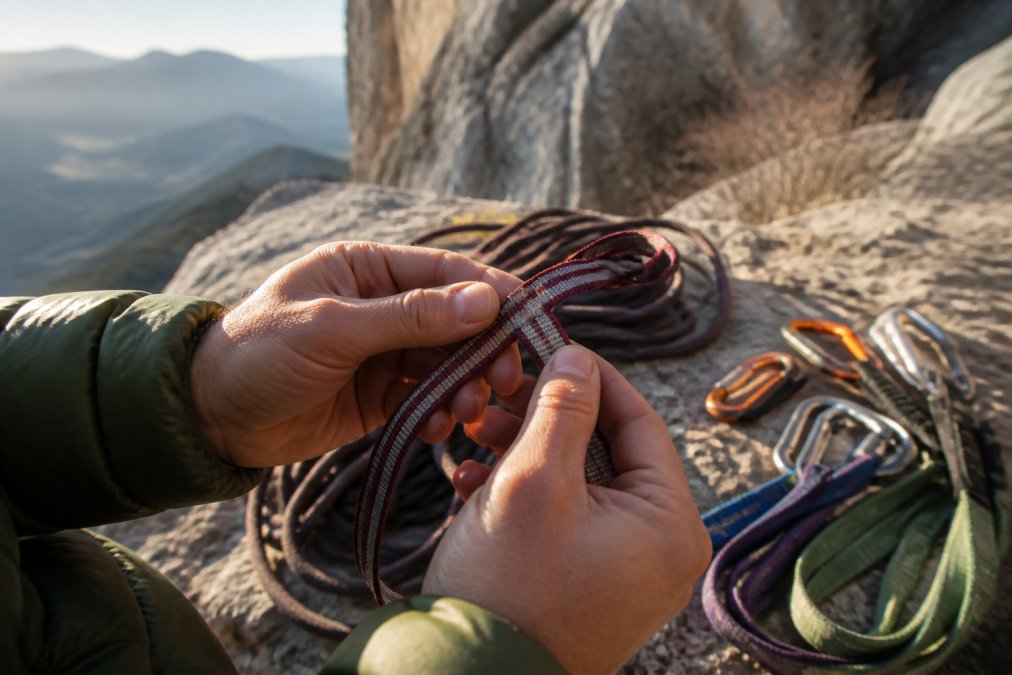
The sewn loop and bar tack deserve your closest attention. Check the stitching for any pulled threads, gaps, or signs that the bar tack has shifted. A sling loaded over a sharp edge, even once, may have hidden core damage. If a sling has sustained a hard fall, been used for rappelling directly through the webbing, or contacted chemicals like battery acid, retire it immediately.
The Bending Test for Hidden Damage
Surface inspection alone is not enough. Perform a simple bending test to reveal internal fiber damage. Hold the sling in both hands and bend it sharply over your thumb, creating a tight crease. A healthy sling will bend smoothly and spring back. A sling with internal fiber damage will feel 'crunchy' or 'gritty' at the crease point. This test is particularly important for Dyneema slings, which can suffer core damage without showing any surface abrasion.
Sling Management: Preventing Wear Before It Starts
The most effective way to extend the life of your slings is to prevent unnecessary wear through smart racking and organization.
The Tangle Problem
A common mistake is storing slings loosely coiled in a gear bin where they can chafe against carabiners and other hardware. Instead, keep slings flaked or loosely coiled in a dedicated stuff sack to prevent unnecessary abrasion between uses.
Racking for Sport Climbing
For sport climbing, rack your 60cm slings on a single carabiner, clipped through both ends, to keep them organized. For 120cm slings used as alpine draws, pre-clip one carabiner to each end and rack them on your gear loop by the top carabiner for quick, one-handed deployment.
Racking for Trad and Alpine
On a trad or alpine rack, rack slings by size, with the shortest on the outside and the longest on the inside. For multi-pitch routes, consider racking all your slings on a single large carabiner or a gear sling to keep them off your harness.
The 'Sling Shot' Method
A technique used by many alpine climbers to prevent tangling is the 'sling shot' method. Clip one end of a 120cm sling to your gear loop, reach through the loop and pull the other end through, creating a compact, non-twisting bundle, then clip the second carabiner to your gear loop. This allows for quick deployment: unclip the top carabiner and give the sling a shake to open it up.
By combining a rigorous inspection routine with smart sling management, you are not just checking for damage, you are actively preventing it.
When to Retire Climbing Slings: Key Retirement Criteria
Climbing slings should be retired when they show visible damage, after a significant fall, or based on age guidelines that vary by material and usage frequency. The American Alpine Club equipment care guidance recommends replacing soft goods like slings every one to three years for frequent climbers, while occasional users may extend that to five years if inspection reveals no issues.
Retirement triggers include frayed or cut webbing, discoloration from UV degradation, stiffness or brittleness from chemical exposure, a visible reduction in width at any point, or a hard fall that loaded the sling beyond its elastic limit. Dyneema slings deserve extra scrutiny because their lower melting point makes them more susceptible to heat damage.
The UIAA equipment retirement recommendations state that soft goods have a finite lifespan even without visible wear, as fibers degrade from micro-abrasion and environmental exposure over time. Mark your slings with the purchase date using a permanent marker so you can track their age accurately.
Final Checks Before You Buy
Before you commit to a set of climbing slings, run through a final checklist that covers certification, intended use, and honest assessment of your climbing objectives. Verify that each sling carries EN 566 compliance and, where available, UIAA certification.
Match your material choice to your primary discipline. If you climb mostly sport routes and gym walls, nylon's durability and handling make it the sensible pick. If your objectives point toward alpine terrain and long multi-pitch routes, the weight savings of Dyneema justify its higher cost and more careful handling.
For beginners building their first rack, AdventureTrailhead carries a full selection of certified slings, ropes, and mounting hardware designed for progression from gym climbing to serious outdoor objectives. Our outdoor climbing rope collection includes static ropes and accessories that pair with your slings for complete anchor systems. Start with two 120cm nylon slings and one 240cm Dyneema sling, and you'll have a versatile foundation that serves most climbing scenarios.
The reliability of your gear ultimately comes down to the care you invest in selection, inspection, and retirement. Choose certified products from trusted sources, inspect before every use, and retire without hesitation when criteria are met.
Frequently Asked Questions
What is the difference between nylon and Dyneema climbing slings?
Nylon slings are more elastic and absorb more energy during a fall, making them better for anchor building where dynamic loading is a risk. They also have a higher melting point and offer better knot holding. Dyneema slings are much stronger for their weight, making them lighter and less bulky for alpine draws. However, they are less abrasion resistant and have a lower melting point, so they handle dynamic falls and friction poorly.
How long do climbing slings last before they need to be replaced?
There is no set expiration date, but regular use means you should inspect them before every climb. A good rule is to retire climbing slings after 10 years from the manufacture date, regardless of use. If you climb frequently, especially outdoors where they face UV degradation and abrasion, you should replace them sooner. Check for signs of wear like fraying, cuts, or stiffness before every use.
What length climbing sling should I buy for trad climbing?
For trad climbing, a 120cm (or 60cm when doubled) sling is the most versatile and a good starting point. A standard rack often includes a few 60cm slings for quick draws and shorter placements, and a couple of 120cm slings for building anchors around larger features. A 240cm sling is useful for equalizing anchors on multi-pitch routes where you need more extension.
Are sewn slings safer than tied slings?
Sewn slings are generally considered safer and are the industry standard. They are tested to meet EN 566 standards and have a higher breaking strength because the bar tack stitching is done in a controlled factory environment. Tied slings using a water knot are acceptable for some uses but can loosen over time and reduce the webbing's strength at the knot. For critical life support, sewn slings are the reliable choice.
Choosing reliable climbing slings requires understanding material trade-offs, safety standards, and honest maintenance habits. AdventureTrailhead provides certified climbing and mountaineering gear, from slings to ropes and belay equipment, so you can build anchors with total confidence. Get started with AdventureTrailhead and equip your rack with gear that performs when the exposure gets real.