
Lightweight Tents for Solo Backpackers: 2026 Comparison
Table of Contents
- Quick Comparison: Lightweight Tents for Solo Backpackers
- Freestanding vs Trekking Pole Tents: Which Setup Suits Your Style?
- Ultralight Tent Weight Limits: What Solo Backpackers Can Realistically Carry
- Backpacking Tent Footprint Necessity: Protection or Extra Ounces?
- Top Lightweight Tents for Solo Backpackers in 2026
- Durability and Repairability: What Most Tent Comparisons Miss
- Conclusion
- Frequently Asked Questions
Last Updated: September 15, 2026
Quick Comparison: Lightweight Tents for Solo Backpackers
Choosing among lightweight tents for solo backpackers in 2026 comes down to a simple split: trekking pole shelters for the lowest weight, freestanding tents for the most forgiving setup. For most solo hikers, the Trekker Tent 1 from AdventureTrailhead hits the sweet spot at 2 lbs 13 oz for $65.00. This guide breaks down weight limits, footprint necessity, freestanding versus trekking pole designs, and long-term durability.

Key comparison at a glance:
| Tent | Price | Type | Best For |
|---|---|---|---|
| Trekker Tent 1 | $65.00 | Trekking pole, 1-person | Ultralight thru-hiking |
| Camping Single Person Tent | $80.90 | Freestanding, 1-person | Budget solo backpacking |
| Ultralight Hiking Climbing Tent | $758.56 | Double-wall, 2-person | Premium alpine use |
The Trekker Tent 1 is the lightest of the three at 2 lbs 13 oz, with a 48-inch center height and a 38-inch sleeping chamber sized for someone 6'4" or under. It pitches with a single trekking pole, handle up, or by tying the peak to a low branch.
Freestanding vs Trekking Pole Tents: Which Setup Suits Your Style?
Freestanding tents stand on their own poles, while trekking pole tents rely on your hiking poles for structure and shed weight as a result. A freestanding design is faster to pitch on hard, rocky ground where stakes won't bite; a trekking pole tent is lighter but needs good stake placement or a creative anchor.
The Camping Single Person Tent ($80.90) uses sturdy aluminum supporter poles, so it stands without trekking poles, making it the better choice for beginners or anyone pitching on rock slabs. The Trekker Tent 1 saves weight by using the pole you're already carrying.

Ultralight Tent Weight Limits: What Solo Backpackers Can Realistically Carry
Ultralight tent weight limits for solo backpackers typically sit between 2 and 4 pounds, with trekking pole shelters at the low end and double-wall freestanding tents at the high end (rei.com). What matters on trail is how shelter weight fits into your total base weight, everything you carry minus consumables like food, water, and fuel.
Experienced solo backpackers often target a base weight of 12 to 18 pounds for three-season trips, with shelter at roughly 15 to 25 percent of that total (Time for Ultralighters to Stop Obsessing About the 10-Pound Baseweight). That puts a practical ceiling on shelter weight:
- Sub-2 lb shelters (trekking pole, single-wall, DCF or silnylon): leave maximum room for a warmer quilt, a heavier pad, or camera gear.
- 2-3 lb shelters (trekking pole double-wall, or lightweight freestanding): the sweet spot for most solo hikers who want livability without sacrificing too much.
- 3-4 lb shelters (freestanding double-wall, heavier fabrics): workable for weekend trips or colder conditions where you're already carrying more insulation.
Trail Weight vs. Packed Weight vs. Minimum Weight
Manufacturers report three different numbers, and comparing them across brands trips up most buyers:
- Minimum weight excludes stakes, guylines, and stuff sacks, the number that looks best in marketing.
- Trail weight includes stakes and guylines but not the stuff sack. This is the number to compare.
- Packed weight includes everything that ships in the box.
The Trekker Tent 1 weighs 2 lbs 13 oz and ships with 9 lightweight red aluminum stakes plus pre-attached guylines, so its trail weight is close to its packed weight. The Camping Single Person Tent weighs 24.3 oz and folds to 14.6 x 3.9 inches, small enough to disappear into a side pocket. The Ultralight Hiking Climbing Tent uses 20D nylon with a 15D silicon-coated rainfly, trading interior volume for low weight and weather resistance.

Packed Volume Matters as Much as Grams
A 2 lb shelter that packs to a long, thin cylinder can be harder to load than a 2 lb 8 oz shelter that compresses into a short, wide bundle. Pack volume is fixed, so a shelter that fits alongside a bear canister or a 20-degree quilt without forcing a repack is worth more than a few saved ounces. Trekking pole shelters pack smaller because they have no integrated pole set; freestanding tents carry their own poles, which adds bulk even when weight is competitive.
Where Weight Savings Actually Come From
Weight comes out of a shelter in four places: fabric denier, pole material, floor thickness, and feature count. Dropping from 30D to 20D nylon saves ounces but reduces puncture resistance. Carbon poles save weight but lose the field-repairability of aluminum. Thinning the floor from 210D oxford to 20D nylon makes a footprint nearly mandatory on abrasive terrain. Removing a second door, full-coverage fly, or vestibule changes wind-driven rain performance. Every ultralight shelter is a set of these trade-offs, the right pick depends on which ounces you'll spend on comfort and which you'll trade for speed.
Backpacking Tent Footprint Necessity: Protection or Extra Ounces?
A backpacking tent footprint is optional for most solo hikers, but it earns its place on abrasive or wet ground, protecting your floor from rocks, roots, and abrasion that shorten a shelter's lifespan. The Camping Single Person Tent already uses a 210D oxford cloth bottom, tougher than most ultralight floors.
If your tent floor is thin 20D nylon, a footprint is cheap insurance. If it's a heavier oxford weave, you can often skip it and save the ounces.
Top Lightweight Tents for Solo Backpackers in 2026
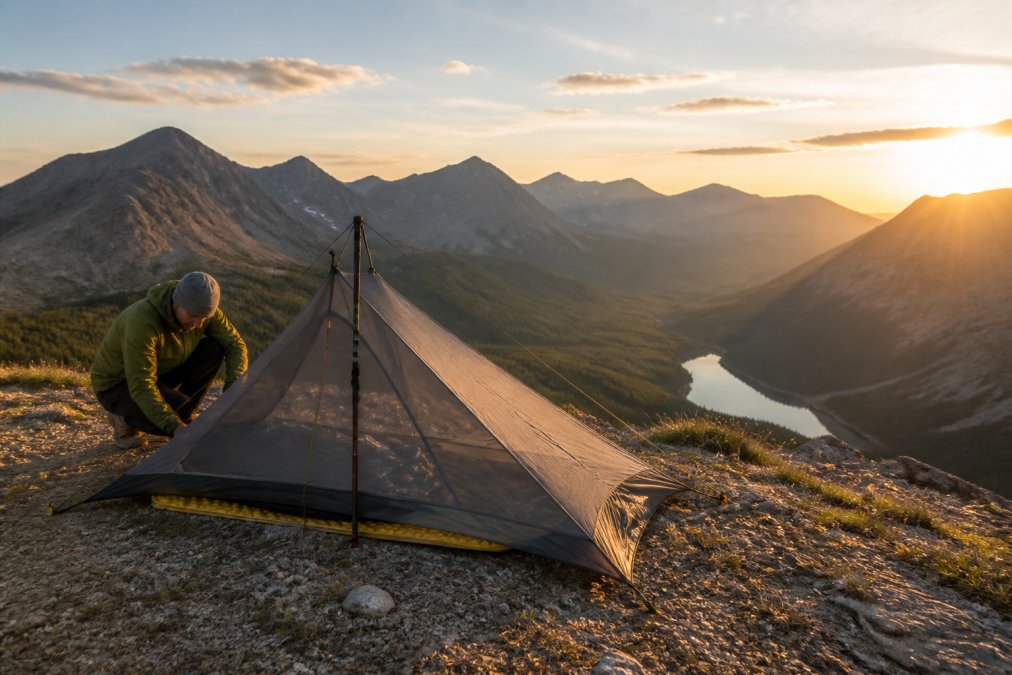
The best lightweight tents for solo backpackers in 2026 balance trail weight, packed size, and weather protection. Here are three AdventureTrailhead options, ranked by use case.
Trekker Tent 1: Best Ultralight Trekking Pole Tent
The Trekker Tent 1 is the lightest option here at 2 lbs 13 oz and $65.00. It sets up with a single trekking pole, handle up, or by tying the peak to a low tree branch. A protected vestibule keeps your pack and boots dry, and it ships with 9 lightweight red aluminum stakes plus pre-attached guylines. The 38-inch sleeping chamber and 48-inch center height suit most solo hikers up to 6'4". It does require a trekking pole or tree branch, so it's less convenient for car camping.
Camping Single Person Tent: Best Budget Ultralight Option
At $80.90 and 24.3 oz, this freestanding tent is the easiest to pitch of the three. Sturdy aluminum poles, a breathable yarn mesh opening, and a 210D oxford cloth bottom make it solid for camping near streams. It packs to 14.6 x 3.9 inches with a storage sack.
Ultralight Hiking Climbing Tent: Best Premium Double-Wall Shelter
Durability and Repairability: What Most Tent Comparisons Miss
How Fabric Denier Predicts Longevity
Field Repair: What Actually Breaks and How to Fix It
Climate-Specific Durability and Condensation
A Repair Kit That Fits in a Stuff Sack
Conclusion
Frequently Asked Questions
What is the ideal weight for a solo backpacking tent?
For solo backpackers, a trail weight between 2 and 3 pounds is the sweet spot. The Trekker Tent 1 weighs just 2 pounds 13 ounces, which keeps your base weight low without sacrificing the vestibule space you need for gear storage. Going below 2 pounds usually means a single-wall trekking pole design that demands more careful site selection and condensation management. Above 4 pounds, you are adding noticeable strain on multi-day trips.
Are trekking pole tents worth the investment for solo hikers?
Trekking pole tents save weight by eliminating dedicated poles, and they pack down smaller than freestanding options. The trade-off is that they require proper staking and tensioning, which takes practice. If you already carry trekking poles, the weight savings are essentially free. If you hike without poles, a freestanding design may suit you better. The Trekker Tent 1 can also be pitched by tying the peak to a low tree branch, adding flexibility.
How do I choose between a freestanding and non-freestanding tent?
Freestanding tents stand up on their own, making them easier to pitch on rocky or hard-packed ground where stakes will not drive in. Non-freestanding tents, including trekking pole models, are lighter and pack smaller but depend on stakes and guy lines for structure. For exposed alpine routes or sites with limited stake placement, freestanding wins. For long-distance thru-hiking where every ounce counts, a trekking pole tent is usually the better call.
Is a 1-person tent enough space for a solo backpacker?
A 1-person tent provides enough room for sleeping and keeping your pack in the vestibule, but livability depends on peak height and floor area. The Trekker Tent 1 offers a 48-inch center height and a 38-inch wide sleeping chamber, which suits someone up to 6 feet 4 inches. If you want to sit up fully, store gear inside, or bring a dog, consider a 2-person tent for the extra interior volume at a modest weight penalty.
What are the most durable lightweight materials for 2026 tents?
Silnylon and silpoly remain popular for their balance of weight, waterproofing, and cost. Dyneema Composite Fabric (DCF) is the lightest and strongest option but costs significantly more and packs bulkier. The Ultralight Hiking Climbing Tent uses 20D nylon with a 15D silicon-coated rainfly, which offers solid weather resistance at a reasonable weight. Whichever material you choose, seam sealing and proper care extend the tent's lifespan considerably.