
How Long Do Climbing Ropes Last? A 2026 Guide
Table of Contents
- Shelf Life vs. Usage Life: What Actually Determines Rope Retirement
- Why an Unused Rope Still Has an Expiration Date
- Signs of Climbing Rope Damage: What to Look For Before Every Climb
- Your Climbing Rope Inspection Checklist: A Step-by-Step Routine
- How to Store Climbing Ropes to Maximize Their Lifespan
- Dynamic vs. Static Rope Retirement: Different Rules for Different Ropes
- Chemical Contamination and Environmental Micro-Climates: The Hidden Threats
- Logbook Tracking: The Simple System That Removes the Guesswork
- Conclusion
- Frequently Asked Questions
Last Updated: September 16, 2026
Shelf Life vs. Usage Life: What Actually Determines Rope Retirement
How long do climbing ropes last? The honest answer is that a climbing rope has two clocks running at once: a shelf life that starts the day it's manufactured, and a usage life that starts the day it first leaves your pack. Whichever clock runs out first retires the rope. This guide from AdventureTrailhead breaks down both, because most climbers only track one.

Why an Unused Rope Still Has an Expiration Date
Storage conditions decide how quickly an unused rope ages. Ultraviolet radiation breaks down nylon at a molecular level, so a rope left on a sunny shelf degrades faster than one kept in a cool, dark bin. Heat accelerates the same oxidation process. Humidity matters too: prolonged damp storage encourages hydrolysis in the polyamide.
UIAA safety commission guidance on rope care and retirement
Signs of Climbing Rope Damage: What to Look For Before Every Climb
Signs of climbing rope damage show up in three places: the sheath, the core, and the overall feel of the rope. Run your hands along the full length and watch for these:
- Flat spots or soft sections where the core has collapsed
- Glazing or melted fibers from a fast rappel or belay slip
- Fuzziness where the sheath has abraded against rock
- Stiffness in one section versus the rest of the rope
- Discoloration or chemical smells that suggest contamination
Sheath Damage vs. Core Damage: Know the Difference
Sheath damage is visible and often survivable. A cut or frayed sheath exposes the core but doesn't necessarily compromise the load-bearing structure underneath, though it does accelerate core wear and should be monitored closely.
Your Climbing Rope Inspection Checklist: A Step-by-Step Routine
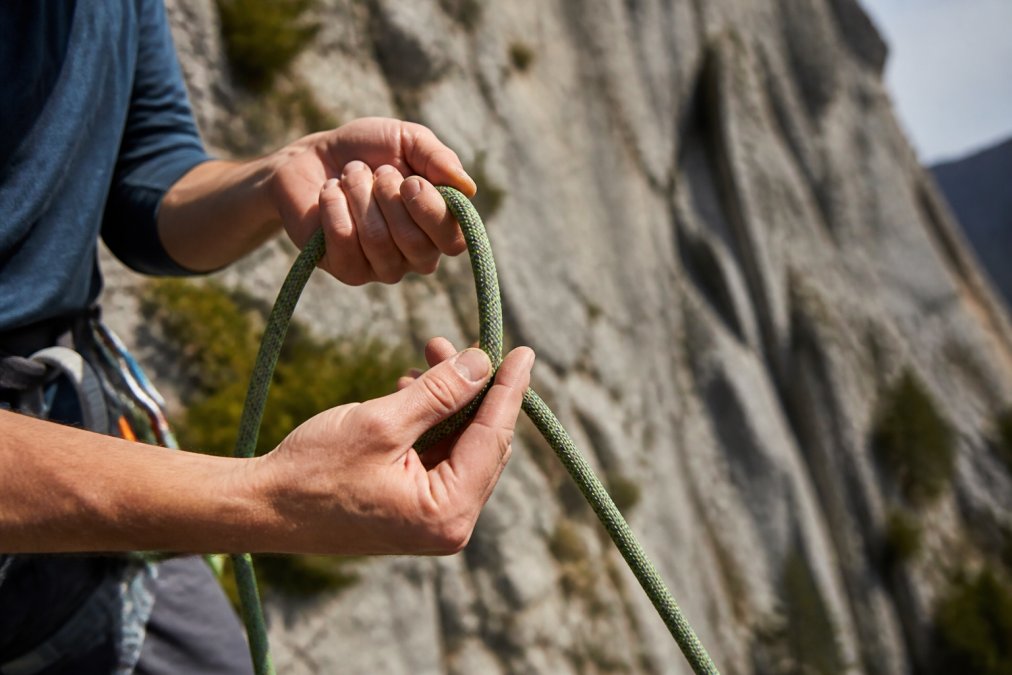
A climbing rope inspection checklist is a repeatable routine, not a one-time glance. Run this before every climb and a full version monthly:
- Find the manufacture date on the end label and note it.
- Run the full length through your hands, feeling for flat spots, lumps, and soft sections.
- Inspect the sheath for cuts, glazing, fuzziness, and discoloration.
- Pinch-test suspect sections to check whether the core has collapsed.
- Check both ends for excessive wear near the tie-in and belay points.
- Smell the rope for chemical odors that indicate contamination.
- Log the inspection with the date and any findings.
How to Store Climbing Ropes to Maximize Their Lifespan
Storage is the one variable you fully control, and it's also the one most climbers get wrong in ways that don't show up until years later. The goal is simple: slow the two chemical processes that age nylon, oxidation and hydrolysis, and keep UV radiation off the fibers.
The Three Enemies, Ranked by How Fast They Work
Ultraviolet light is the fastest killer. UV breaks the polyamide chains directly, and the damage is cumulative, a rope that spends a season draped over a sunny fence post loses strength even on days it never gets used. Keep ropes out of direct sun, including on the drive to the crag.
Environmental Micro-Climates Matter More Than You Think
Two climbers can store ropes in identical bins for the same number of years and end up with very different ropes. The difference is the micro-climate around the bin.
- Coastal and salt-air environments: Salt is hygroscopic, it pulls moisture out of the air and holds it against the fibers. A rope stored in a garage a few blocks from the ocean sees constant low-grade dampness that a mountain climber's rope never experiences. Rinse and fully dry ropes after coastal trips, and shorten inspection intervals.
- Desert and high-UV environments: The heat is obvious, but the bigger issue is that UV exposure happens year-round, not just on climbing days. A rope that lives in a truck bed or open garage in the Southwest accumulates UV dose every single day.
- Humid basements and garages: A dehumidifier in the gear room is one of the cheapest lifespan extenders you can buy. Target a stable, dry space rather than a space that's merely out of the sun.
- Cold storage: Cold itself isn't damaging, but freeze-thaw cycles that pull condensation onto the rope are. Let a cold rope come to room temperature before storing it long-term.
Practical Storage Rules
- Coil loosely or use a rope bag, tight, compressed coils create stiff spots over months.
- Never store ropes next to gasoline, solvents, battery acid, or pool chemicals. Vapors alone can contaminate nylon.
- Don't hang a rope over a metal hook or nail for years; the contact point can develop a permanent kink.
- Keep the manufacture label readable. If you can't find the date, you've lost the shelf-life clock entirely.
UIAA safety commission guidance on rope care and retirement
Dynamic vs. Static Rope Retirement: Different Rules for Different Ropes
Most rope-retirement guides treat every rope the same, which is why so many climbers either retire good ropes too early or push worn ones too far. Dynamic and static ropes are built for different loads, age on different clocks, and should be retired on different evidence.
Dynamic Ropes: Fall Energy Is the Real Clock
A dynamic rope's job is to stretch and absorb the energy of a fall. Every leader fall loads the core with energy it has to dissipate, and that energy is what degrades the rope over time. This is why fall count, not just calendar age, drives dynamic rope retirement.
Where the rope is used also changes the math:
- Gym ropes see high cycle counts but low fall factors, lots of top-rope laps and short falls. They wear out from abrasion and sheath fuzz more than from core-damaging impact force.
- Sport crag ropes take repeated leader falls, often on the same few meters near the anchors. Expect faster core fatigue and more frequent inspection of the working ends.
- Trad and alpine ropes may take fewer falls but see more abrasion, edge loading, and environmental exposure. Age and visual wear often retire them before fall count does.
Static Ropes: Calendar Age and Abrasion, Not Fall Count
A static rope is built for low-stretch work, hauling, rigging, fixed lines, and rescue systems. It is not designed to absorb a leader fall, and it should never be used for lead climbing. Because it rarely takes impact energy, its retirement triggers are different:
- Calendar age from the manufacture date, following the manufacturer's maximum shelf life.
- Abrasion at contact points, edges, carabiners, haul devices, and anchor hardware.
- Load cycles from repeated hauling and rigging, which fatigue fibers even without a fall.
- Visible damage, glazing, sheath cuts, core exposure, or stiff spots.
Side-by-Side Retirement Triggers
| Rope Type | Primary Wear Driver | Retirement Trigger | Typical Use |
|---|---|---|---|
| Dynamic, gym | Abrasion, sheath fuzz, cycle count | Sheath wear plus calendar age | Top-rope laps, indoor climbing |
| Dynamic, sport | Fall energy, impact force | Fall count plus age | Lead climbing on bolts |
| Dynamic, trad/alpine | Abrasion, edge loading, environment | Visual wear plus age | Multi-pitch, alpine routes |
| Static | Abrasion, UV, load cycles | Calendar age plus visual wear | Hauling, rigging, fixed lines |
The Rule That Cuts Across All of Them
Whichever type you're holding, the shorter clock wins. A dynamic rope that's never been fallen on still ages out on the shelf-life clock. A static rope that looks pristine still retires on calendar age. Track both, and retire on the first trigger, not the last.
American Alpine Club guidance on gear inspection and retirement
Chemical Contamination and Environmental Micro-Climates: The Hidden Threats
Chemical contamination is the retirement reason most climbers never check for. Nylon is vulnerable to acids, solvents, and petroleum products, and a rope that soaks up even a small amount can lose strength without any visible damage. If your rope touched a fuel spill, a cleaning solvent, or battery acid, retire it. There's no way to test your way back to trust.
American Alpine Club guidance on gear inspection and retirement
Logbook Tracking: The Simple System That Removes the Guesswork
A rope log is the single most useful habit you can build, because it turns vague memory into a record. Track four things for every rope: the manufacture date, the purchase date, the number of significant falls, and every inspection with its findings.
Conclusion
The hard part of rope retirement isn't the inspection, it's the discipline to actually do it and log what you find. AdventureTrailhead stocks the gear that supports that habit, from climbing ropes and mountaineering equipment to the rope bags and soft goods that keep your kit organized and protected between trips. Our catalog includes a 10-meter static climbing rope with a polyester sheath and high-strength core rated for 1,000 to 5,000 kg, plus an 8mm Predator rope sold by the foot for rappelling and technical setups.

Frequently Asked Questions
How do I know if my climbing rope is bad?
Check for these signs of climbing rope damage: flat or soft spots when running the rope through your fingers, glazing or stiffness from heat damage, excessive fuzziness or sheath slippage, and core shots where the inner core is visible. Also look for chemical stains or unusual discoloration. If you find any of these, retire the rope immediately. When in doubt, err on the side of safety and replace it.
Does a climbing rope expire if it is never used?
Yes. Even unused climbing ropes degrade over time due to exposure to ultraviolet radiation, moisture, and oxygen. Most manufacturers recommend retiring an unused dynamic rope after 10 years from the date of manufacture. However, if the rope has been stored in a cool, dark, dry place and shows no signs of damage, some manufacturers allow up to 10 years. Always check the manufacturer specifications for your specific rope.
What are the UIAA standards for rope retirement?
The UIAA (Union Internationale des Associations d'Alpinisme) does not set a fixed retirement age. Instead, it provides guidelines based on use: retire a dynamic rope after a major fall (fall factor 2), after 3-5 years of frequent use, or after 10 years of occasional use. For static ropes, retirement is typically after 5-10 years depending on use. Always follow the manufacturer's recommendations, which may be more conservative.
What should I do with an old climbing rope?
Retired climbing ropes can be repurposed for non-life-safety uses: as a rug, a dog leash, a gear sling, or for crafting. Many outdoor retailers offer recycling programs. AdventureTrailhead encourages responsible disposal; check local recycling centers that accept nylon or polyester. Never sell or give away a retired rope for climbing purposes, as its strength may be compromised.