
Is a Climbing Helmet Really Necessary? What to Know
Table of Contents
- The Real Job of a Climbing Helmet
- Rock Fall vs. Impact Protection: What a Helmet Can and Can't Do
- When to Wear a Climbing Helmet: Discipline by Discipline
- UIAA Helmet Certification: What the Labels Actually Mean
- Climbing Helmet vs Bike Helmet: Why You Can't Swap Them
- When to Replace a Climbing Helmet
- Fit, Weight, and the Psychology of Wearing One
- Conclusion
- Frequently Asked Questions
Last Updated: September 29, 2026
The Real Job of a Climbing Helmet
A climbing helmet is a piece of protective headgear designed to absorb and distribute the force of falling rock, ice, or debris before it reaches your skull. That is the entire job, and it is narrower than most people assume. At AdventureTrailhead, we sell helmets every week to climbers heading into Yosemite's big-wall routes and to beginners booking their first gym session, and the same confusion comes up in both conversations: people buy a helmet expecting it to save them from every bad outcome, then wonder whether it was worth the weight.
Rock Fall vs. Impact Protection: What a Helmet Can and Can't Do
Rock fall protection and impact protection are two different engineering problems, and most climbing helmets are optimized for the first. A helmet's shell spreads the force of a falling object across a wider area, while the EPS foam liner crushes on impact to absorb energy. That combination handles a fist-sized rock falling from above.

- Rock fall: the primary threat on multi-pitch routes, below other parties, and in gullies
- Impact protection: relevant during a whipper, a swing into a wall, or a tumble on approach terrain
- Side impact: tested under the newer standards, and the reason modern helmets extend lower at the back and sides
When to Wear a Climbing Helmet: Discipline by Discipline
The short answer: wear a climbing helmet any time there is a realistic chance of something falling on your head or your head hitting something. The useful answer is a framework with three inputs, exposure to falling objects, exposure to a fall or swing, and how much control you have over either. Run every situation through those three and the decision usually makes itself.
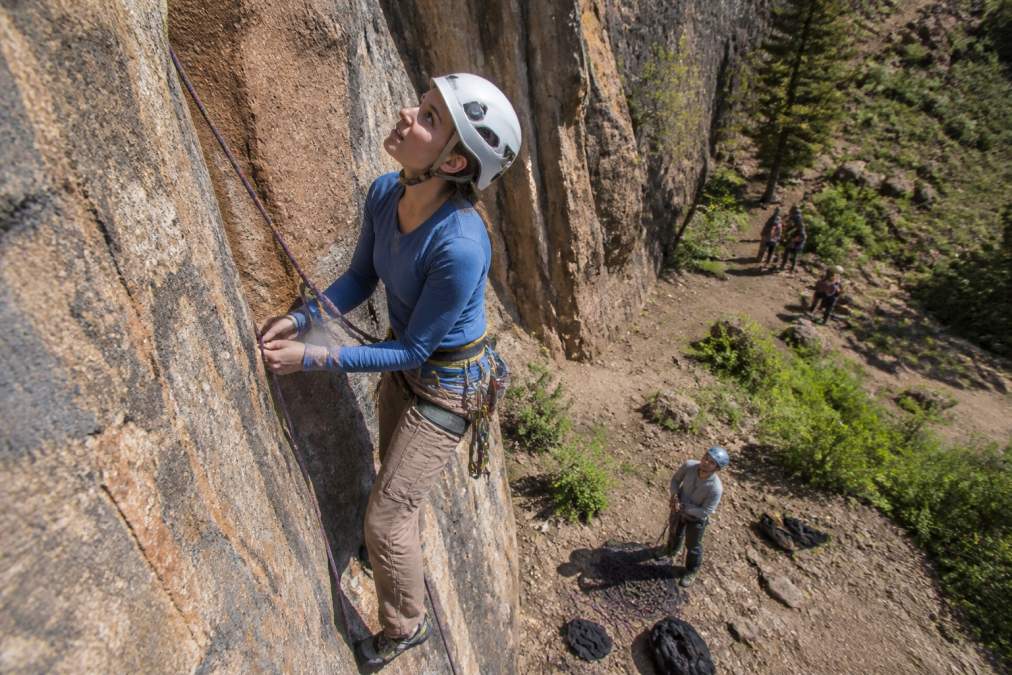
Indoor Gyms, Top-Rope, and Sport Crags
Gyms are the one setting where a helmet is genuinely optional. There is no natural rock fall, the landing surfaces are padded, and the falls are controlled by a belay system. The hazards that remain are human: a beginning belayer who short-ropes you into the wall, a crowded bouldering area where someone tumbles off an adjacent problem, or an awkward swing that puts your head near a volume or hold.
Multi-Pitch, Mountaineering, and Class 3 Terrain
This is where a climbing helmet stops being a preference and becomes standard practice, and the reason is exposure time. On a single-pitch sport route you might be under a hazard for ten minutes. On a multi-pitch route you are exposed to rock fall from above for hours, often with parties you cannot see or communicate with. The longer the exposure window, the more the odds shift against you.
UIAA Helmet Certification: What the Labels Actually Mean
A climbing helmet's certification tells you what test it passed, not how it will perform in every scenario. The two standards you will see are EN 12492, the European standard, and UIAA 106, the International Climbing and Mountaineering Federation's equivalent. Both test impact absorption, penetration resistance, and retention system strength.
| Standard | Applies To | Side Impact Tested | Retention Tested |
|---|---|---|---|
| EN 12492 | Climbing and mountaineering helmets | Yes | Yes, front and back |
| UIAA 106 | Climbing and mountaineering helmets | Yes | Yes, front and back |
| CPSC (bike) | Bicycle helmets | No | Yes, rear only |
Climbing Helmet vs Bike Helmet: Why You Can't Swap Them
A bike helmet and a climbing helmet are not interchangeable, even though they look similar. The core difference is the side-impact test. Bike helmets are built for a forward fall onto pavement, and CPSC testing reflects that. Climbing helmets are built for a fall against a vertical surface, and EN 12492 and UIAA 106 reflect that.
When to Replace a Climbing Helmet
Most guides tell you to replace a climbing helmet every five to ten years and leave it there. That number is a manufacturer's conservative ceiling, not a measurement of your helmet. A helmet has two clocks running at once, and whichever runs out first is the one that matters.
Clock One: The Foam Liner
The EPS foam liner absorbs energy by crushing, a one-time job. Once compressed, it cannot compress again, which is why a helmet that takes a significant impact is done regardless of how the shell looks. The shell can spring back and look untouched while the foam underneath has already spent its protection.
Clock Two: The Shell and Straps
The shell spreads force and resists penetration, and it degrades differently. UV exposure is the main enemy: polycarbonate and ABS shells break down under sustained sunlight, becoming brittle and prone to cracking. A helmet that lives on the outside of your pack on every approach gets a UV dose on every trip. Webbing and buckles age too, nylon straps stiffen and fray, and plastic buckles can develop hairline cracks invisible until they fail under load.
How to Read the Date Stamp
Every certified climbing helmet carries a date of manufacture, usually stamped or molded inside the shell near the certification marking, often as a month-and-year code. Check it before you buy, because a helmet that has been on a warehouse shelf for two years is two years closer to retirement. Check it again each season, and write the purchase date on tape inside the shell if the stamp is hard to read.
A Practical Replacement Schedule
- After any significant impact: replace immediately, no exceptions, even if the helmet looks new.
- Heavy use or heavy UV exposure: most manufacturers suggest replacing in the three-to-five-year range.
- Occasional use, stored indoors: the five-to-ten-year ceiling applies, but treat it as a ceiling, not a target.
- Any helmet of unknown age or history: replace it. A secondhand helmet with no date stamp is not a bargain.
Signs it is time to retire a helmet:
- Visible cracks, dents, or deep scratches in the shell
- A liner that has compressed, hardened, or separated from the shell
- A chin strap or buckle that no longer holds tension or shows fraying
- A shell that feels brittle or chalky to the touch
- Any helmet that took a direct hit, regardless of appearance
Gear maintenance is not glamorous, but a helmet is one of the few pieces of climbing equipment where the failure mode is your head. Treat the replacement schedule as part of the sport, and the date stamp as the first thing you check, not the last.
Fit, Weight, and the Psychology of Wearing One
For climbers who want a single helmet that covers climbing, mountaineering, and general outdoor use, the Outdoor Helmet from AdventureTrailhead uses an ABS and PC shell with a high-density EPS liner and adjusts from 52 cm to 62 cm. Pair it with a full body climbing harness for rope work and rappelling, or a half-body harness for lighter climbing days.


Conclusion
The uncomfortable truth is that most climbing accidents involving head injuries happen on terrain the climber considered easy. Rock fall does not check your grade, and a slip on class 3 terrain does not care how experienced you are. A climbing helmet is not a guarantee, but it is the cheapest insurance you will ever buy for the one part of your body you cannot replace.
Frequently Asked Questions
Why do so many climbers skip wearing a helmet?
Most climbers who skip helmets are on low-risk terrain, like a well-bolted sport route with clean rock above, and they weigh that against comfort and weight. Others find helmets hot on long routes or dislike how they sit with long hair. The decision usually comes down to objective hazards, such as loose rock or other parties above, versus subjective factors like personal tolerance for risk. On class 3 terrain or multi-pitch routes, that tradeoff rarely favors going bareheaded.
Does a climbing helmet protect against every kind of impact?
No. A climbing helmet is built mainly for falling objects, like rock fall, and for the kind of head contact you get in a tumble or short fall. It absorbs energy through an EPS foam liner and spreads force across a polycarbonate or ABS shell, but it is not designed for high-speed vehicle-style crashes. Side impact coverage also varies by model, so check the shape and how far the shell extends before you buy.
How long does a climbing helmet last before it needs replacing?
Most manufacturers recommend replacing a climbing helmet about every five years from the date of manufacture, even if it looks fine. EPS foam and the shell materials degrade from UV exposure, heat, and repeated minor knocks. Replace it immediately after any significant impact, if the shell is cracked or deeply gouged, if the foam is compressed, or if the suspension system and chin strap no longer adjust securely. Check the manufacture date stamped inside before you buy.
Can I use a bike helmet for climbing instead?
A climbing helmet vs bike helmet comparison comes down to what each is tested for. Bike helmets are certified for a single high-speed impact and often have more vents and a lighter shell. Climbing helmets are tested for repeated impacts from above, including penetration by sharp objects, which is the rock fall scenario. A bike helmet offers no penetration protection and no rated side impact for climbing use, so it is not a safe substitute on rock.