
Climbing Gear Safety Certification Explained
Table of Contents
- What Climbing Gear Certification Actually Means
- UIAA vs CE Climbing Gear Standards: What's the Difference?
- Key EN Standards by Gear Category
- Climbing Gear Breaking Strength Explained
- How Long Do Climbing Ropes Last?
- How to Spot Counterfeit Gear and Verify What You Buy
- Frequently Asked Questions
Last Updated: September 11, 2026
What Climbing Gear Certification Actually Means
Climbing gear safety certification explained in plain terms: an independent organization tested a piece of equipment against a published standard and confirmed it performs as claimed. The CE mark is the visible result in Europe.
CE (Conformité Européenne) is a certification mark indicating that a product complies with the relevant European health, safety, and environmental protection legislation. For climbing hardware, ropes, and harnesses, that legislation is the Personal Protective Equipment (PPE) Regulation.
A CE mark is not a quality badge. It is a legal declaration backed by testing.
The CE Mark and the PPE Regulation
The PPE Regulation classifies climbing equipment as category III, the highest risk tier (europa.eu). Category III products must undergo a conformity assessment involving a notified body before the CE mark can be affixed: technical documentation, type-examination of samples, and production quality assurance.
The category III classification is why your harness carries a label with a batch number, a standard reference, and a notified body's four-digit code.
What a Notified Body Does
A notified body is an independent testing organization designated to assess whether a product meets the applicable standard. It reviews the design, performs or witnesses testing, and issues a certificate if the gear passes.
The four-digit number next to the CE mark identifies which notified body performed the assessment. A bare "CE" with no digits on a harness or carabiner is incomplete, treat it as a red flag.
UIAA vs CE Climbing Gear Standards: What's the Difference?
The UIAA standard is generally stricter than the CE baseline. The UIAA (Union Internationale des Associations d'Alpinisme) publishes its own safety standards, and many manufacturers test to both. A product can carry the CE mark without UIAA certification, but UIAA certification is the stronger signal.
The UIAA also runs a Safety Label program, with standards reviewed on a fixed cycle to keep pace with materials and manufacturing methods.
Where the Two Systems Overlap
Both systems test breaking strength, impact force, and durability under repeated loading, but diverge in thresholds and methods, the UIAA often sets a higher bar for impact force on dynamic ropes and holding power on hardware.
Key EN Standards by Gear Category
The EN standard that applies to your gear depends on what the gear is. A rope and a carabiner are tested against completely different documents, and knowing which number applies is the fastest way to verify a product.
| Gear Category | Standard | What It Covers | Key Marking to Look For |
|---|---|---|---|
| Dynamic climbing ropes | EN 892 | Impact force, dynamic elongation, number of falls held | EN 892, type (single/half/twin), diameter, UIAA fall rating |
| Static ropes | EN 1891 | Static elongation, sheath slippage, tensile strength | EN 1891, type A or B, diameter |
| Connectors and carabiners | EN 12275 | Gate open strength, major axis strength, marking | EN 12275, type letter (B, D, H, K, X, Q), strength in kN |
| Harnesses | EN 12277 | Waist and leg loop strength, drop testing | EN 12277, type (A, B, C, D), size |
| Helmets | EN 12492 | Impact absorption, retention system strength | EN 12492, size range |
| Slings and webbing | EN 566 | Sling strength, loop strength | EN 566, length, strength in kN |
| Belay and rappel devices | EN 15151-1 / -2 | Braking performance, holding force | EN 15151, part number |
| Pulleys | EN 12278 | Strength, efficiency, rope compatibility | EN 12278, strength in kN |
| Ascenders and descenders | EN 567 / EN 12841 | Grip strength, slip resistance | EN 567 or EN 12841, type |
| Ice axes and crampons | EN 13089 / EN 893 | Shaft strength, point sharpness, retention | EN 13089 or EN 893 |
EN 892, EN 12275, and EN 12277 Explained
EN 892 governs dynamic rope. It limits impact force, requires a minimum number of standardized falls, and caps dynamic elongation so the rope absorbs energy without turning a fall into a bounce. The UIAA fall rating is the number of test falls the rope survived; a higher rating means a more durable but often stiffer rope with higher impact force, a real trade-off.

EN 12275 covers connectors, including carabiners and quicklinks. It defines minimum major-axis breaking strength, specifies gate open strength, and assigns a type letter: B for basic, D for directional, H for via ferrata, K for via ferrata with a captive eye, X for oval, and Q for quicklinks. A type B carabiner used where a type K is required is a misuse, even if the strength numbers look adequate.
EN 12277 applies to harnesses and specifies strength requirements for the waist belt and leg loops, plus a drop test simulating a real fall. Type letters: A for full-body, B for sit, C for chest, and D for combination or work-positioning harnesses. A harness labeled EN 12277 type C is a chest harness, not a standalone fall-arrest device.
Why the Standard Number Alone Is Not Enough
Two carabiners can both say EN 12275 and still be very different. The standard sets a floor, not a ceiling: a manufacturer can exceed the minimum gate open strength, add a captive eye, or change the gate mechanism, and the label still reads EN 12275. That is why the type letter, strength rating in kilonewtons, and gate type matter as much as the standard number.
The Lifecycle of a Standard
Standards are not frozen. EN 892, EN 12275, and EN 12277 have all been revised, and gear compliant when made may not meet the current revision. That does not automatically make older gear unsafe, it was tested against the rules in force at manufacture. When buying new gear, check that the label references the current revision; when inspecting older gear, do not assume a familiar standard number meets today's thresholds. Most manufacturers publish the revision year on the label or in technical documentation.
How This Interacts with North American Requirements
The EN and UIAA systems appear on most climbing gear sold worldwide, but they are not the only frameworks. In the United States, ANSI and ASTM publish standards for some climbing and fall-protection equipment, and OSHA regulates fall protection for workers at height. A harness for industrial rope access may carry an ANSI or ASTM reference instead of an EN number, and a product certified only to a North American standard may not carry a CE mark at all. Read the label for the standard that applies where you are using the gear.
UIAA safety standards and label program
ASTM standards for climbing and fall protection
Climbing Gear Breaking Strength Explained
Breaking strength is the load at which a component fails, always stated for a defined axis and configuration. A carabiner rated on its major axis will fail at a much lower load if loaded crosswise or with the gate open, not a defect, but how the rating is defined.
Tensile strength, load testing, and breaking strength get used interchangeably, but they differ. Tensile strength is a material property. Breaking strength is the measured failure point of a finished component. Load testing is the procedure that establishes it.
Why Gate Open Strength Matters More Than You Think
Gate open strength is the load a carabiner can sustain while its gate is open, typically a fraction of the closed-gate rating. In a fall, a carabiner can be loaded with the gate open if the rope or sling presses against it.
How Long Do Climbing Ropes Last?
A dynamic climbing rope typically lasts three to five years of regular use, or up to ten years with light use, but the calendar is a rough guide. The real determinant is use, storage, and inspection: impact force from a severe fall, abrasion over an edge, and chemical exposure all shorten a rope's life far more than time alone.
Retire a rope immediately if you find:
- Core shots, where the sheath is cut and the core is visible
- Flat or stiff sections that will not relax
- Glazing or a shiny, fused sheath from heat or friction
- Soft or mushy spots that suggest core damage
- Any rope that took a severe fall over a sharp edge
Static elongation and sheath slippage most often reveal a rope is past its prime, a rope that has lost its ability to absorb energy is no longer doing the job it was certified to do. Store ropes dry, out of sunlight, and away from solvents, and keep a written log of use.
How to Spot Counterfeit Gear and Verify What You Buy
Counterfeit climbing gear is the biggest certification gap most buyers never think about. A fake harness can carry a convincing CE mark, a real-looking standard number, and packaging that copies a legitimate brand, and it will fail the moment it is loaded.
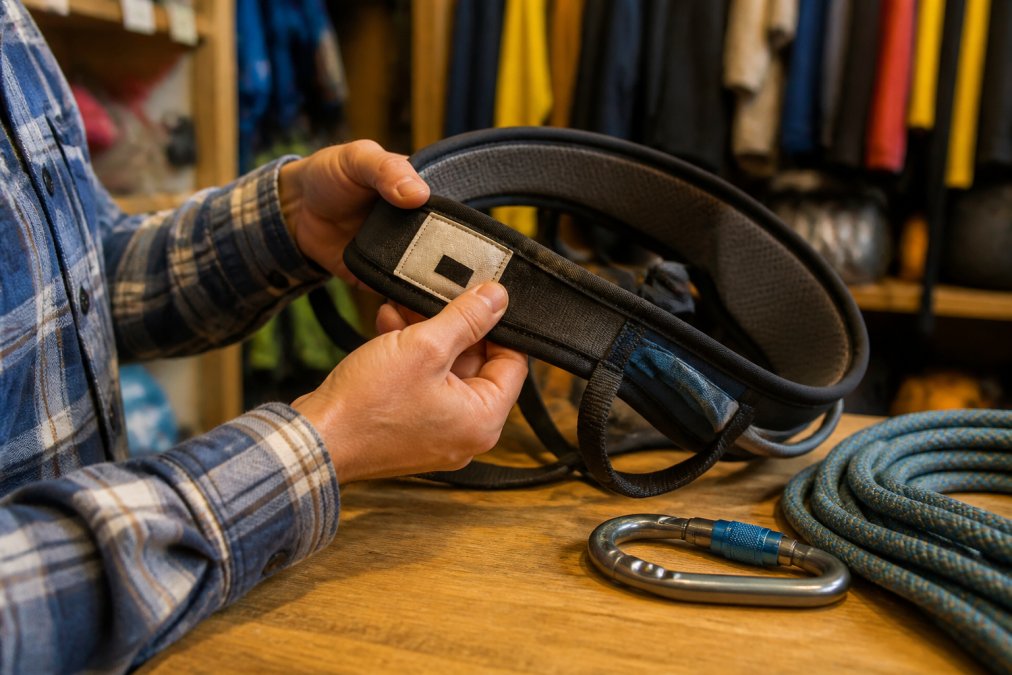
The Field Verification Method
The verification process is the same in a store or online. Do these in order, and stop at the first failure:
- Find the four-digit notified body number next to the CE mark. A bare "CE" with no digits on load-bearing gear is incomplete.
- Confirm the standard number matches the gear category. A harness should reference EN 12277, not EN 892. A rope should reference EN 892 or EN 1891, not EN 12275. A mismatched number is a strong counterfeit signal.
- Check the type letter. EN 12275 connectors carry a type letter (B, D, H, K, X, Q), and EN 12277 harnesses carry a type letter (A, B, C, D). A label with the right standard number but no type letter is suspect.
- Look for a batch or lot number. Traceability is a requirement of the conformity process. Gear with no batch number cannot be traced back to a production run.
- Inspect stitching, hardware finish, and weight against a known-good example. Counterfeits often use lighter hardware, uneven stitching, or a different finish. If you own the real version, compare side by side.
- Buy from retailers who can show where the gear came from. A retailer who cannot name the distributor or country of manufacture is a risk, regardless of how the label looks.
What Each Gear Category's Label Should Contain
The markings required by the standard differ by category, so a single checklist does not work.
- Dynamic rope (EN 892): standard number, rope type (single, half, or twin), diameter, UIAA fall rating, impact force, elongation, manufacturer, and a traceable batch or serial number.
- Static rope (EN 1891): standard number, type A or B, diameter, static elongation, sheath slippage, and tensile strength.
- Carabiner or connector (EN 12275): standard number, type letter, major axis strength in kilonewtons, minor axis strength, gate open strength, and a batch number. Strength is usually stamped into the metal, not printed on a sticker.
- Harness (EN 12277): standard number, type letter, size, manufacturer, and a batch or serial number. The label is usually sewn into the waist belt or leg loop.
- Helmet (EN 12492): standard number, size range, and manufacturer. The label is typically inside the shell.
If a label is missing any of the category-specific items above, treat the gear as unverified until confirmed with the manufacturer or a reputable retailer.
Red Flags That Point to a Fake
A few patterns show up repeatedly in counterfeit climbing gear:
- A CE mark with no notified body number on a load-bearing item
- A standard number that does not match the gear category
- Strength ratings printed on a sticker rather than stamped or molded into the product
- Packaging that copies a brand's look but misspells the brand name or the standard number
- A price far below the market range for that category of gear
- A seller who cannot provide a batch number or a certificate of conformity on request
When to Walk Away
If you cannot confirm the notified body number, the standard number, and the batch number, do not buy the gear for life-safety use. The cost of a legitimate harness or carabiner is small compared to the cost of a failure. Buy from a retailer who stands behind the product and can trace it to a manufacturer.
AdventureTrailhead stocks climbing and mountaineering equipment we can stand behind, including harnesses and ropes built to recognized standards. If you want gear you can trust on a rock face, start with our Outdoor Safety Belt Climb Rock Safety Harness or the Full Body Climbing Harness with Multi D Ring Support for rope access work.


Frequently Asked Questions
What does 22 kN mean on a carabiner?
The 22 kN figure is a carabiner's major-axis breaking strength, meaning it can withstand roughly 22 kilonewtons of force before failing, about 4,900 pounds. That number assumes the gate is closed and the load runs along the spine. Carabiners also carry a gate-open strength rating, usually around 7 kN, and a minor-axis rating near 8 kN. Always clip so the load rides the major axis with the gate closed.
What is the difference between UIAA and CE certification for climbing gear?
CE marking is a legal requirement under the EU Personal Protective Equipment Regulation, showing a product meets minimum safety standards and was assessed by a notified body. UIAA certification is voluntary and comes from the International Climbing and Mountaineering Federation, which sets additional testing criteria for climbing-specific gear. A harness can carry the CE mark without UIAA approval, but UIAA-certified gear must also meet CE requirements.
How do I know if my climbing gear is safe to use?
Check three things: the certification label, the manufacturing batch or serial number, and the gear's history. Legitimate gear carries a CE mark with a four-digit notified body number and often a UIAA label. Retire any gear with visible damage, corrosion, or a fall that loaded it hard. Ropes, harnesses, and slings also have manufacturer expiration dates. When in doubt, retire it. Replacement costs far less than a failure on the wall.
Are there specific safety standards for climbing ropes?
Yes. Dynamic ropes fall under EN 892, which sets requirements for impact force, number of falls held, and static elongation. Static ropes follow EN 1891. The UIAA adds its own tests, including sheath slippage and a u-shaped bend test, that push ropes harder than the base EN standard. A rope carrying both EN 892 and UIAA marks has passed the stricter of the two testing regimes.
How often should I replace my climbing rope?
Most manufacturers recommend retiring a dynamic rope after three to five years of regular use, or sooner if it has held multiple hard falls. Retire immediately after a factor-two fall, visible core damage, or sheath slippage. Store ropes away from sunlight, chemicals, and heat. A rope that only sees weekend use may last longer, but inspect it before every trip and log its history.
Can I trust climbing gear bought online?
Buy from retailers who source directly from manufacturers and can show certification documentation. Counterfeit harnesses and carabiners exist, often sold through marketplaces at suspiciously low prices. Check for a legible CE mark with a notified body number, a UIAA label if applicable, and a manufacturing batch code. If the label looks printed rather than stitched or stamped, or the price is far below market, walk away.