
Can You Use a Static Rope for Rappelling?
Table of Contents
- Can You Use a Static Rope for Rappelling?
- What Static Rope Is Designed For
- Why Low Stretch Matters on Rappel
- Static vs Dynamic Rope for Rappelling: The Core Differences
- The Physics of Shock Loading on a Static Line
- Device Compatibility and Rope Diameter: What Actually Works
- Canyoneering vs Rock Climbing: Where Static Rope Rappelling Shines
- How Long Do Climbing Ropes Last?
- Rappelling Safety Best Practices
- Frequently Asked Questions
Last Updated: October 2, 2026
Can You Use a Static Rope for Rappelling?
Yes, you can use a static rope for rappelling, and in many situations it is the better choice. Static rope's low stretch holds firm under body weight, making descents more controlled and predictable. This guide from AdventureTrailhead breaks down when a static rope works, when it does not, and how to stay safe.

Static rope is a kernmantle cord engineered to stretch very little under load, usually under 5% at working loads. A dynamic rope is the opposite: it stretches to absorb the energy of a fall.
Rappelling puts a steady load on a rope, not a sudden jolt, so the stretch that protects a falling climber is not needed. What you need is control, and low stretch delivers it.
What Static Rope Is Designed For
Static rope is made for work, not for falling. It is the standard choice for rope access, rescue, caving, and long fixed lines.
These tasks share a steady load, a known path, and no expectation of a fall: a window washer on a high-rise, a rescue tech lowering a litter, a caver descending a shaft.
The trade-off is simple. Static rope gives you control and abrasion resistance. It gives you almost nothing in the way of fall protection.
Why Low Stretch Matters on Rappel
Low stretch matters on rappel because it keeps your descent predictable. When you weight a static line, it barely gives, so your brake hand controls the speed, not the rope's bounce. With a dynamic rope, every shift in body weight produces a small spring, fine on a climb, but on a long rappel it makes your footing feel vague and your speed harder to judge.
So the question "can you use a static rope for rappelling" has a clear answer. Yes, and for pure descent work it is often the smarter pick.
Static vs Dynamic Rope for Rappelling: The Core Differences
The core difference comes down to elongation. Static rope stretches very little under load; dynamic rope stretches a lot, on purpose, to soak up fall energy.
| Feature | Static Rope | Dynamic Rope |
|---|---|---|
| Elongation under load | Very low | High by design |
| Best use | Rappelling, fixed lines | Lead climbing, falls |
| Descent control | Firm, predictable | Bouncy, less precise |
| Fall protection | Almost none | Absorbs fall energy |
| Abrasion resistance | High | Moderate |
Elongation and Stretch Characteristics
Elongation is how much a rope lengthens under load. Static ropes keep this low, often under a few percent at working loads; dynamic ropes are built to stretch much more. Neither is a flaw, each rope is tuned for a job. When you rappel, you load the rope with body weight, not a fall, so low elongation keeps that load steady and your descender bites consistently.
Coefficient of Friction and Heat Management
The coefficient of friction is how much grip a rope has against your device. A stiffer static line runs hotter through a device on fast descents, friction turns speed into heat, and too much heat can glaze the sheath and weaken the rope over time.
Manage it the same way you manage any rappel:
- Keep your speed steady, not fast
- Use a device rated for your rope diameter
- Check the sheath for glazing after long, hot descents
- Add friction with a leg wrap or extra biner on long drops
The Physics of Shock Loading on a Static Line
Shock loading is what happens when a sudden force hits a rope that cannot stretch. A dynamic rope spreads a fall's energy over time and distance; a static rope has almost no give, so the same energy hits all at once and the peak force spikes.
Why Fall Factor Changes Everything
Fall factor is the distance you fall divided by the length of rope in the system; a factor of 1 means you fell the full length of the rope out, and higher factors mean bigger forces (Fall factor and impact force - theory). On a dynamic rope, a factor 1 fall is survivable because the rope stretches. On a static rope, that same fall can generate forces high enough to break gear, anchors, or a climber's body. Static lines are for lowering, hauling, and descent, not for catching falls.
Device Compatibility and Rope Diameter: What Actually Works
Device fit is where a lot of rappel problems start. Your descender and rope diameter have to match, and the rope's construction, not just its diameter, changes how the device bites. Most rappel devices list a working range for rope diameter; stay inside it. But a stiff, low-stretch static line feeds and brakes differently than a soft, dynamic line of the same thickness, because the sheath is tighter and the core is less compressible. Here is how common descenders behave with static versus dynamic line of the same diameter:
| Device | Typical rope range | Static rope behavior | Dynamic rope behavior |
|---|---|---|---|
| Tube/ATC-style | ~8.5-11 mm | Firm brake, less feed; can feel grabby on thin static | Smoother feed, softer brake |
| Figure-8 | ~8-13 mm | Very fast, high heat; stiffness reduces the twist it adds | More twist, slightly slower |
| Rappel rack | ~9-13 mm | Excellent heat control; bars bite consistently | Bars bite less predictably |
| Munter hitch (carabiner) | ~7-11 mm | Strong brake, more friction, harder to feed | Feeds easier, brakes softer |
| Auto-locking descender (e.g., Petzl I'D-style) | Device-specific | Usually rated for both; verify the manual | Usually rated for both; verify the manual |
Two patterns show up again and again:
- Static line runs hotter and faster through low-friction devices. A figure-8 on a stiff static line can hit speeds that glaze a sheath in a single long drop. A rack or a tube device gives you more friction to work with.
- Static line brakes harder in high-friction devices. A Munter or a tube device on a thin static line can feel grabby, which makes smooth lowering harder, not easier.
The fix is not to pick a rope and hope. It is to match the rope to the device and then test the pair.
Matching Rope to Belay Device and Descender
Match the rope to the device, not the other way around. Each device grips differently and has a diameter window that works best. A practical sequence:
- Read the device manual and note the rated rope diameter range.
- Pick a rope inside that range, and prefer the middle of the range over the edges.
- Rig the system on flat, safe ground, no higher than a few feet.
- Weight the rope and confirm the brake strand feeds smoothly without you having to fight it.
- Watch for sheath slippage on very stiff or very slick ropes; if the sheath slides over the core, retire the rope.
A 10 mm static line and an 8 mm static line do not feed or brake the same way, even in the same device. The 8 mm runs faster and heats up quicker; the 10 mm brakes harder. Neither is wrong, they are different tools.
If you are building a dedicated rappel setup, choose the device first, then buy a rope in the middle of its rated range. That habit prevents most brake-hand problems people blame on the rope.
Canyoneering vs Rock Climbing: Where Static Rope Rappelling Shines
Static rope rappelling shines in canyoneering, where the day is mostly descent.
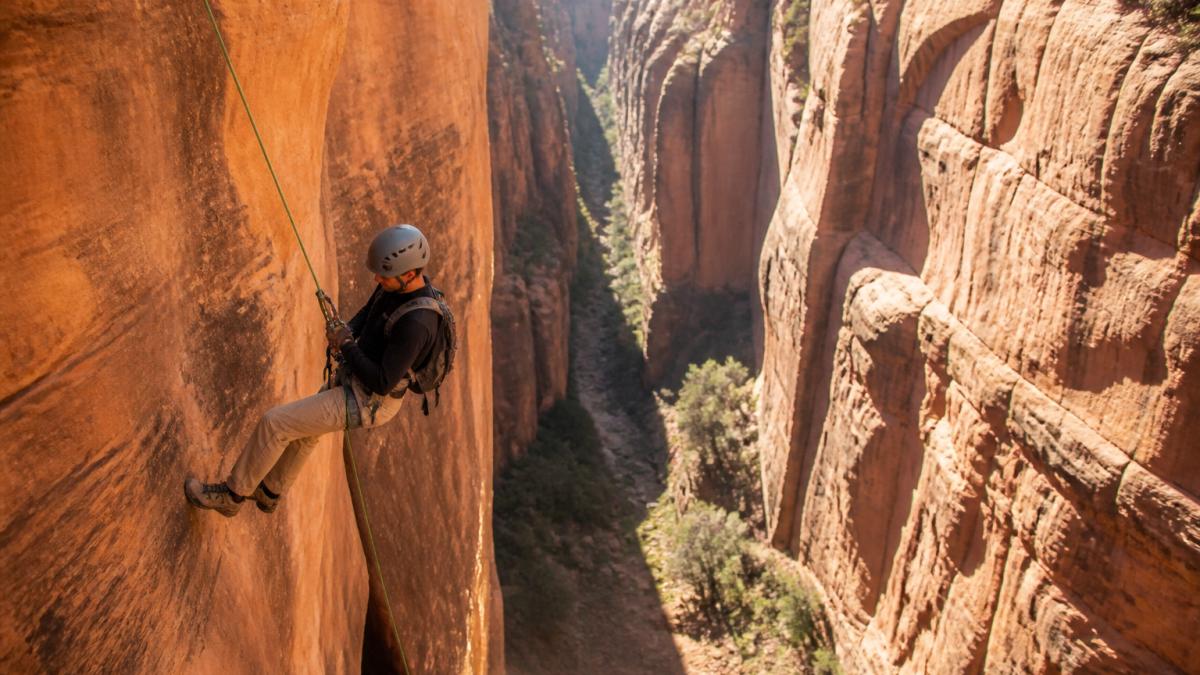
Canyoneering also punishes ropes in ways climbing does not:
- Wet, gritty rope. Canyons hold water and sand. A static line's tight sheath sheds grit and resists abrasion better than a soft dynamic sheath.
- Sharp, irregular edges. Sandstone lips and limestone flakes cut. Static rope's higher abrasion resistance buys you margin.
- Repeated short rappels. A canyon might have 10 to 20 drops in a day. Low stretch keeps each one predictable, so your brake hand does not have to recalibrate every time.
- No fall potential on the descent. You are lowering, not leading. The one thing static rope cannot do, absorb a fall, is the one thing you are not asking it to do.
Rock climbing is a different story. A climbing day mixes ascent and descent, and lead falls are part of the deal, that is dynamic rope territory.
So the context decides it:
- Canyoneering and pure descent: static rope is often the best tool, especially on retrievable single-strand systems.
- Rope access and rescue: static rope is standard, and often required by the employer's fall-protection program.
- Lead climbing with fall potential: use a dynamic rope, every time.
- Top-rope with a possible short fall: dynamic rope is the safer default.
The rope does not have one job. The terrain, the descent style, and the fall potential decide which rope belongs on the wall, ask those three questions and the static-versus-dynamic choice usually answers itself.
How Long Do Climbing Ropes Last?
Most climbing ropes last between three and ten years depending on use, storage, and how often they take falls. A rope used hard every weekend wears out sooner than one used a few times a season.
Retire a rope when you see any of these:
- Flat or stiff spots along its length
- Cuts, glazing, or a fuzzy, worn sheath
- Sheath slippage where the core and sheath separate
- Damage from chemicals, heat, or sunlight over time
- A hard fall on a dynamic rope near its limit
For static lines, watch the sheath at the anchor and device points, where friction and heat do the most damage. Inspect before every trip, not once a year.
Rappelling Safety Best Practices
Rappelling safety comes down to a few habits you repeat every time, on a 20-foot practice wall or a 200-foot canyon drop.
- Always keep a firm brake hand on the rope
- Double-check your harness, device, and anchor before you leave the ground
- Tie a stopper knot at the end of the rope
- Use a backup, such as an autoblock, below your device
- Match your rope diameter to your device
- Carry a way to ascend if you get stuck
- Rappel with a partner who can check your setup
A full-body harness with D-rings front, back, and on the hips gives you secure attachment points for rappelling and rope access work. AdventureTrailhead stocks this gear because the right setup lets you descend with confidence.

Frequently Asked Questions
Can you rappel on a static rope?
Yes. Static rope rappelling is standard practice in canyoneering, caving, and rescue work. The low stretch keeps you close to the anchor and reduces bounce on descent. The main rule is to keep the system weighted and avoid any dynamic loading. A 10mm polyester sheath rope with a high-strength core, like the Outdoor climbing rope10M, handles rappel duty well when you stay within its rated capacity.
What are the disadvantages of static rope?
The biggest drawback is shock absorption. A static rope has very little elongation, so a fall generates higher force on the anchor, the rope, and your body. It also wears faster at the sheath in repeated rappels over sharp edges, and sheath slippage becomes a concern on older lines. Static rope is not for lead climbing. Reserve it for rappelling, top-rope setups, and fixed lines where the load stays predictable.
How long do climbing ropes last?
Most manufacturers suggest retiring a climbing rope after five years of light use or sooner with heavy use. Inspect after every trip for sheath damage, soft spots, glazing, or core exposure. A rope used often for rappelling, especially over abrasive rock, may need retirement in one to two seasons. Log your outings and replace any rope that has taken a serious fall or shows flat spots.
Is it safe to use static rope for lead climbing?
No. Lead climbing involves falls with a fall factor that only a dynamic rope can absorb safely. A static rope transmits that force straight to the anchor, the protection, and the climber. UIAA standards require dynamic elongation for lead lines for this reason. Keep static rope for rappelling, fixed lines, and hauling. Use a dynamic rope anytime there is a real chance of a fall.
Rappelling safely starts with matching the right rope to the right job. At AdventureTrailhead, we stock the climbing and mountaineering gear that makes that choice simple, from static lines and rappel kits to full-body harnesses built for real descents. Explore our climbing collection to gear up with equipment you can trust on the wall. Get started with AdventureTrailhead and descend every route with total confidence.