
Cabela's vs Decathlon for Hiking Gear: 2026 Comparison
Table of Contents
- Cabela's vs Decathlon for Hiking Gear: How the Two Stores Compare
- Best Budget Hiking Gear Brands and Where to Find Them
- Essential Hiking Gear Checklist for Beginners
- Durability and Trail Performance: Denier Fabric, Waterproof Ratings, and Field Testing
- Where Each Store Wins: Ultralight Backpacking vs Camping Essentials
- Gear Maintenance, Repairability, and Warranty Support
- Conclusion: Choosing Your Hiking Gear Strategy
- Frequently Asked Questions
Last Updated: September 13, 2026
Cabela's vs Decathlon for Hiking Gear: How the Two Stores Compare
Cabela's and Decathlon sit at opposite ends of the outdoor retail spectrum, and that gap shapes every gear decision you make between them. Cabela's operates as a full-service hunting, fishing, and camping destination with deep brand-name inventory and in-store expertise. Decathlon runs a house-brand model built on high volume and low margins, which keeps prices down but narrows your choices to what Decathlon designs itself. This comparison from AdventureTrailhead breaks down where each store earns its place in your pack, and where a specialty retailer beats both.
The real question isn't which store is "better." It's which one matches the trip you're actually planning. A weekend car camper and a thru-hiker need completely different answers, and the two chains serve those needs unevenly.
Price Positioning and Cost-to-Performance Ratio
Decathlon wins on raw price. Its house brands undercut nearly every name-brand equivalent, and the savings compound across a full kit. Cabela's charges more per item but frequently discounts house brands like Cabela's Instinct and Bargain Cave clearance, so patient shoppers close much of the gap.
The cost-to-performance ratio flips depending on category. On soft goods, Decathlon's value is hard to beat. On hard goods and technical equipment, Cabela's carries tiers Decathlon simply doesn't stock, so you're not comparing like for like.
| Factor | Cabela's | Decathlon |
|---|---|---|
| Price positioning | Mid to premium | Budget to mid |
| House brand depth | Moderate | Extensive |
| Name-brand selection | Broad | Limited |
| Best value category | Hard goods, optics | Soft goods, basics |
| Try-before-you-buy | Strong in-store | Limited floor stock |
Product Range: Soft Goods vs Hard Goods
Soft goods are apparel, packs, and sleeping bags; hard goods are stoves, trekking poles, and navigation tools. Decathlon's strength lives almost entirely in soft goods, where its in-house design keeps costs low. Cabela's spreads across both, with a hard-goods selection that includes brands Decathlon never carries.
For a beginner building a first kit, that distinction matters less than it sounds. For anyone upgrading technical equipment, it matters enormously.
Best Budget Hiking Gear Brands and Where to Find Them
Budget hiking gear brands cluster around two models: house brands that cut out the middleman, and value lines from established manufacturers. Decathlon's house labels dominate the first category. Cabela's house brands and clearance channels cover the second.
A practical approach is to split your budget by category rather than shopping one store for everything. Spend on footwear and sleep insulation, where failure ruins a trip, and save on apparel layers and accessories, where cheaper options perform nearly as well.
Essential Hiking Gear Checklist for Beginners
The essential hiking gear checklist for beginners covers three systems: what you sleep in, what you wear, and what you carry. Buy those first. Everything else is refinement.
Start with the "big three" of pack, shelter, and sleep system, then add layers and safety items. Beginners who buy accessories before nailing the big three end up replacing everything within a season.
Sleeping Systems and Shelter
Shelter and sleep insulation decide whether you're rested or miserable. For solo backpacking, a trekking-pole tent cuts weight dramatically. The Trekker Tent 1 weighs 2 lbs 13 oz, includes nine aluminum stakes, and pitches with a single trekking pole or a low tree branch. At $65, it undercuts most comparable shelters.
For two or three people, the Pop-up Camping Tent sets up in seconds and includes a PU-coated rainfly and mesh ventilation. Budget-conscious campers can start with a basic Camping Tent at $51.95, available in 2-, 3-, and 4-person sizes.

Footwear and Technical Apparel
Footwear is the one category where budget shopping backfires. Boots and trail runners take the most abuse and protect your joints on descents. Fit matters more than price, which is why in-store try-on still beats online ordering for boots.
Technical apparel follows a simpler rule: moisture-wicking base layers, synthetic insulation mid layers, and a waterproof shell. Denier ratings tell you abrasion resistance; waterproof ratings tell you rain protection. Neither number means much without consistent field testing.
Durability and Trail Performance: Denier Fabric, Waterproof Ratings, and Field Testing
Denier measures fiber thickness, and higher denier means heavier, tougher fabric. A 200D nylon pack body resists branch snags and rock abrasion far better than a 40D ultralight shell (rei.com). Waterproof ratings work on a separate scale, typically expressed in millimeters of hydrostatic head, with higher numbers surviving sustained rain. A 1,500 mm coating handles drizzle; sustained multi-day rain pushes most budget shells past 3,000 mm before seams become the weak point (rei.com).
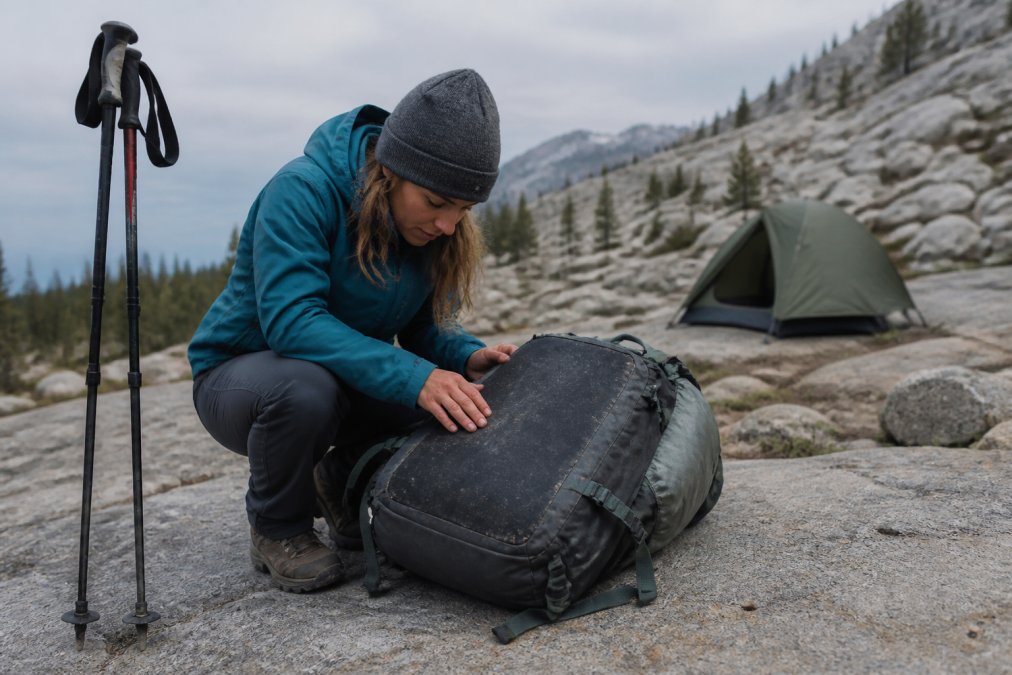
Field testing is where marketing claims meet reality. A pack rated waterproof at the factory still leaks through seams after a season of use unless the coating holds. Zippers, buckles, and strap anchors fail before fabric does on most budget gear. That failure order is what separates a pack you repair from a pack you replace.
Where the Two Retail Models Diverge on Durability
The durability question isn't really about denier. It's about who stands behind the gear when a buckle snaps 40 miles from a trailhead.
Cabela's carries name-brand hard goods with published material specs and manufacturer warranties you can look up before you buy. Its house brands sit in the middle: decent denier counts, standard coatings, and a return window that favors in-store resolution. Decathlon's house-brand model pushes cost down by controlling the whole supply chain, which means durability specs are consistent across a product line but warranty terms are set by Decathlon itself and vary by product family.
A common pattern among long-distance hikers is to treat the two stores differently by category:
- Shelters and packs: Buy the version with replaceable poles, serviceable buckles, and a taped-seam fly. Both stores stock these, but Cabela's name-brand tiers publish more of the spec sheet.
- Soft goods and layers: Decathlon's value holds up here because abrasion exposure is lower and the failure mode is usually a zipper, not fabric.
- Hard goods: Cabela's carries tiers Decathlon doesn't stock, so the durability comparison stops being apples-to-apples.
The Large-capacity Hiking Backpack illustrates the trade-off well. It uses multi-layered 200D nylon, adjusts from 30L to 35L via roll-top closure, and weighs 0.95 kg. That denier count puts it in durable territory without pushing it into expedition-weight territory.

Repairability Is the Spec Sheet Nobody Prints
A pack with a broken buckle is a $4 fix if the buckle is a standard side-release and a dead pack if it's sewn in. A tent with a snapped pole is a warranty claim if the pole is replaceable and a landfill item if it's bonded to the fly. Before you buy from either store, check three things:
- Are the buckles standard sizes you can source replacements for?
- Are the tent poles sold as spare parts?
- Does the shell use a spray-on or wash-in DWR you can reapply, or a factory-bonded membrane you can't?
Cabela's generally offers stronger in-store repair guidance and a physical counter to bring a failed item to. Decathlon's warranty terms vary by product line, and resolution usually runs through the brand rather than a repair desk. Neither store publishes a repairability score, which is exactly why the check above matters more than the marketing copy.
Denier and hydrostatic head tell you how the fabric should behave. Buckle standards, spare-pole availability, and DWR type tell you whether you'll still be using the item in three seasons.
Where Each Store Wins: Ultralight Backpacking vs Camping Essentials
Decathlon wins ultralight backpacking on price and base weight. Its trekking-pole tents and synthetic insulation hit low weights at prices that undercut specialty brands. Cabela's wins camping essentials, where car campers want durable coolers, camp stoves, and comfortable furniture that Decathlon stocks thinly.
The split comes down to how you travel. Ultralight backpackers count every gram and accept thinner margins on durability. Car campers and basecamp users care about comfort, capacity, and how long gear lasts, not weight.
Weight-to-Price Math for Ultralight Kits
Ultralight gear is where the two stores' business models show up most clearly in the numbers. Decathlon's house-brand design lets it sell a trekking-pole tent at a weight and price that name-brand equivalents rarely match. Cabela's ultralight selection leans on established brands, which means you're paying for published specs, tested designs, and a warranty you can trace.
A practical way to compare is weight-to-price ratio: dollars per ounce saved. On shelters and sleep systems, Decathlon usually wins that ratio outright. On packs and technical layers, the gap narrows because Cabela's name-brand tiers publish denier, volume, and load ratings you can verify before ordering.
For a beginner building a first ultralight kit, the honest answer is that Decathlon gets you on trail for less, and Cabela's gets you on trail with more documentation. Neither is wrong; they serve different risk tolerances.
Camping Essentials: Where Cabela's Pulls Ahead
Car camping and basecamp gear rewards capacity, comfort, and longevity over grams. Cabela's stocks the categories Decathlon treats as afterthoughts: hard-sided coolers, multi-burner stoves, camp furniture, and large-family shelter systems. Decathlon's camping aisle is real, but it's built around the same value-first model, which means fewer premium tiers and less brand choice.
For the second group, the Outdoor Camping Bags Hiking Backpack at $156.48 offers a nylon build in three colorways suited to camping and cycling trips where load capacity matters more than gram-counting.

Availability, Shipping, and the Store-vs-Online Trade-off
This is the angle most comparisons skip, and it changes the answer more than price does.
Cabela's strength is physical: a large-format store where you can put hands on a pack, try on boots, and walk out with gear the same day. That matters most for footwear, where fit decides everything, and for anyone leaving on a trip within a week. The trade-off is that not every market has a store within reasonable driving distance, and online inventory doesn't always mirror what's on the floor.
Decathlon's strength is a tightly controlled house-brand catalog that ships consistently, with fewer SKUs to go out of stock. The trade-off is thinner floor stock, so try-before-you-buy is limited and returns often run through the mail rather than a counter.
A common pattern among hikers is to split the purchase:
- Buy in person when fit is the deciding factor: boots, packs, and anything you'll wear against skin for hours.
- Buy online when the spec sheet is the deciding factor: shelters, sleep systems, and accessories where weight and dimensions are published.
- Check the return window before you commit, because a boot that fits in the store can still blister on a 12-mile descent.
Neither store wins this category outright. The winner is whichever one matches how soon you're leaving and how much you need to touch the gear first.
If your trip is inside two weeks, prioritize the store you can physically reach. If you have a month, the online catalog with the better spec sheet usually wins on weight and price.
Gear Maintenance, Repairability, and Warranty Support
Repairability separates gear you keep from gear you replace. Tents with replaceable poles, packs with serviceable buckles, and boots with resolable soles last years longer than sealed units. Cabela's generally offers stronger warranty support and in-store repair guidance; Decathlon's warranty terms vary by product line and region.
Maintenance habits extend lifespan more than any warranty. Dry your tent fully before storage to prevent mildew (nps.gov). Rinse packs after coastal or dusty trips. Store sleeping bags loose, never compressed. Re-waterproof shells annually with a spray-on treatment.
The cheapest gear is the gear you already own that still works. A $12 bottle of seam sealer and a spare buckle kit will outlast most warranty claims.
Conclusion: Choosing Your Hiking Gear Strategy
The hardest part of gear shopping isn't picking a store. It's matching your kit to the trips you'll actually take, and resisting the urge to buy everything at once. Decathlon serves budget-focused beginners and ultralight hikers well. Cabela's serves campers and hunters who want selection and in-store expertise. Neither covers every category equally.
At AdventureTrailhead, we offer a comprehensive selection of essential camping gear, climbing and mountaineering equipment, footwear, outdoor apparel, and water sports gear. Browse our full outdoor collection and gear up with equipment built to hold up trip after trip.
Frequently Asked Questions
Is Decathlon gear good quality for serious hiking?
Decathlon's higher-tier lines hold up for moderate trails, but the entry-level equipment often uses lower denier fabric that wears faster under heavy loads. For long-distance hiking and ultralight backpacking, look for gear with reinforced stitching, taped seams, and a waterproof rating of at least 1,500mm. Durability matters more than brand name when you are miles from a trailhead.
Does Cabela's carry lightweight backpacking equipment?
Cabela's leans toward hunting, fishing, and car camping, so its ultralight backpacking selection is thinner than what you would find at a dedicated outdoor retailer. You can still find trekking poles, sleeping systems, and synthetic insulation layers, but base weight savings are harder to achieve. For gram-counting trips, check specialty options like the Trekker Tent 1 at 2 lbs 13 oz.
How do the price points compare between Cabela's and Decathlon?
Decathlon generally undercuts Cabela's on entry-level equipment, while Cabela's charges more for branded soft goods and hard goods. The cost-to-performance ratio flips depending on category: Decathlon wins on basic apparel, Cabela's wins on hunting-adjacent gear. For budget-conscious hikers, a 30-35L waterproof daypack at $75.99 offers a strong middle ground between the two extremes.
Which store is better for beginner hikers on a budget?
Beginners should prioritize a functional design that covers the essentials without overspending. Decathlon's lower entry prices suit first-time buyers, but Cabela's offers better in-store guidance and return policies. Start with an essential hiking gear checklist for beginners: footwear, a 30-35L pack, a 2-3 person tent, moisture-wicking layers, and a water filter. Upgrade individual pieces as your trail performance improves.
Are there specific hiking items better bought at Cabela's versus Decathlon?
Cabela's excels at hard goods like hunting knives, firearm accessories, and heavy-duty camping equipment. Decathlon performs better on technical apparel, ultralight backpacking accessories, and entry-level trekking poles. For shelter, a pop-up tent at $202.99 or a $65 one-person trekking pole tent covers both ends of the spectrum without needing either big-box store.