
Best Women's Trail Running Shoes for Technical Terrain 2026
Table of Contents
- What Makes a Trail Shoe Ready for Technical Terrain
- Top Women's Trail Running Shoes for Rocky Terrain
- Trail Running Shoes With the Best Grip for Steep Descents
- Technical Trail Shoe Fit and Sizing for Women
- Trail Running Shoes for Wet and Muddy Trails
- How to Choose: Matching Shoe to Surface and Distance
- Verdict: Our Top Picks for Technical Terrain in 2026
- Frequently Asked Questions
Last Updated: October 4, 2026
What Makes a Trail Shoe Ready for Technical Terrain
Finding the best women's trail running shoes for technical terrain 2026 comes down to four things: grip, underfoot protection, stability, and a fit that matches a woman's foot.

Technical terrain is any surface with uneven, unpredictable footing: loose scree, wet roots, embedded rock, mud, steep descents.
Most guides rank shoes by cushioning and treat grip as an afterthought. On technical ground it's the reverse: if your outsole slides, no amount of foam saves you.
The four specs that decide whether a shoe belongs on technical trail:
- Lug depth: how far the rubber teeth protrude, in millimeters
- Outsole compound: the rubber's softness, trading durability for wet grip
- Rock plate or midsole stiffness: what stops a sharp edge from jabbing your arch
American College of Sports Medicine guidance on running footwear notes that shoe selection should match the running surface and individual foot mechanics, not a single universal recommendation.
Top Women's Trail Running Shoes for Rocky Terrain
Rocky terrain punishes thin soles and sloppy fits. Prioritize underfoot protection with a stable platform, so your foot lands predictably on edges and points of rock.
Our women's leather hiking and climbing shoe, the Womens Autumn Winter Tourism Hiking Sports Shoes, is built for exactly this.

The trade-off: leather adds durability and protection but runs warmer than mesh, suiting cooler conditions and rocky descents better than a humid summer climb.
Underfoot Protection and Rock Plate Considerations
A rock plate is a stiff layer between outsole and midsole that spreads point pressure across a wider area. Without one, every sharp edge pokes through; with one, the shoe stays flat underfoot.
For women, protection interacts with fit. A full-length plate adds stiffness, which helps on rock but reduces ground feel on smoother trail. Partial plates sit under the forefoot only, suiting runners who want protection where they land without a rigid ride.
Trail Running Shoes With the Best Grip for Steep Descents
Grip is where technical trail shoes separate, and on steep descents it decides whether you run or slide.
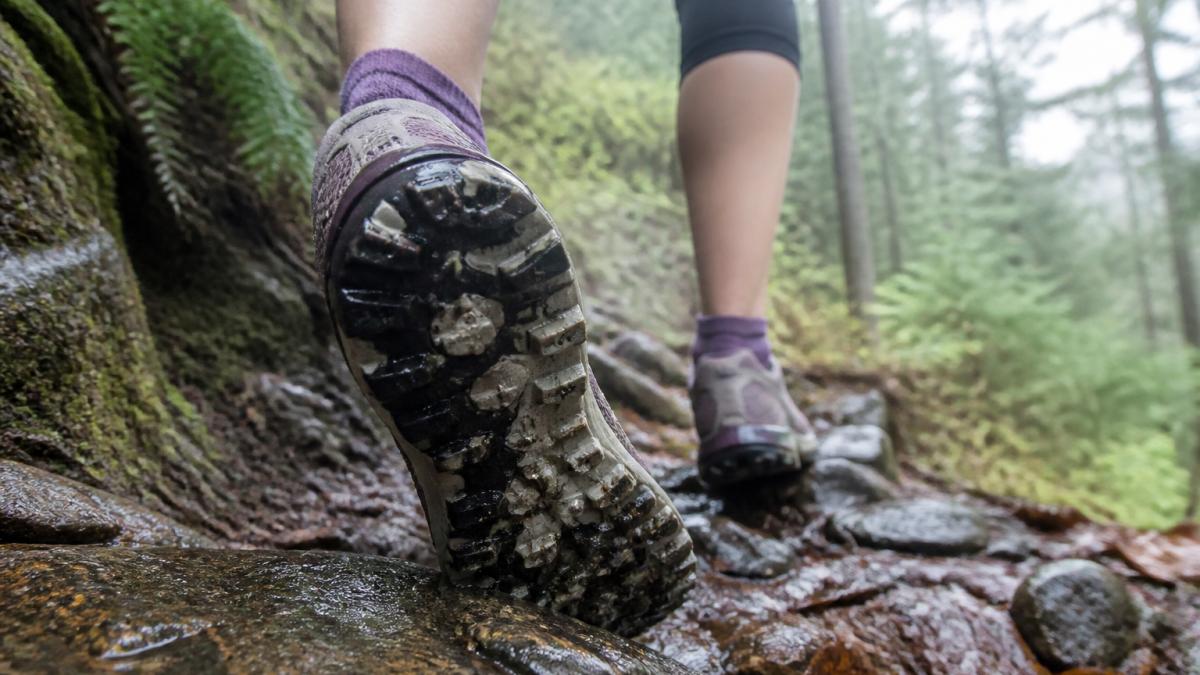
Our Men's Waterproof Trail Hiking Running Shoes show how the pieces fit together: a rubber outsole for flexible, non-slip traction, a waterproof lightweight upper, and a moisture-wicking mesh lining.
One caveat: a highly cushioned, flexible shoe feels vague when braking hard on loose ground. Stiffer, lower-profile shoes transmit more information about what's under you.
Lug Depth and Outsole Compounds Explained
Lug depth is the height of the rubber teeth on the outsole, in millimeters. Shallow lugs suit hardpack and rock; deeper lugs clear mud and bite loose dirt. Outsole compound is the rubber's hardness: softer rubber grips wet rock better but wears faster; harder rubber lasts longer and slides sooner.
Match the two to your surface:
| Surface | Lug Depth | Compound Priority | Why |
|---|---|---|---|
| Wet rock and roots | Shallow to medium | Soft, sticky rubber | Surface contact beats digging in |
| Deep mud | Deep, widely spaced | Harder, self-clearing | Mud sheds instead of packing |
| Loose scree | Medium | Balanced | Grip without tearing apart |
| Mixed technical trail | Medium | Soft-to-medium | One shoe for changing ground |
Surface-by-Surface Grip and Braking Performance
Technical terrain is not one surface, and a shoe that excels on wet rock may fail on loose scree.
Wet rock and roots. The hardest test for any outsole.
Loose scree and gravel. Lug shape matters more than compound softness.
Steep descents and braking. Braking traction depends on lug orientation and heel geometry.
Mud and soft dirt. Wide lug spacing is the priority.
How to Test Grip Before You Buy
You can't replicate a wet rock garden in a store, but a few checks predict real-world grip:
- Press a thumbnail into the outsole rubber. A faint mark that springs back means the compound is soft enough for wet grip. Hard and slick means it will last but slide on wet rock.
- Look at lug spacing. Hold the shoe sole-up. Daylight between lugs means it will shed mud; tightly packed lugs hold soft ground.
- Check the heel lug angle. Lugs angled backward toward the heel bite when you brake on descents. Flat, shallow heel lugs offer less braking traction.
Women's-Specific Grip Considerations
Grip is not just about the outsole. A women's-specific last with a narrower heel and securely anchored midfoot keeps your foot from sliding when you weight the edges on a steep traverse. If your foot moves laterally inside the shoe, your weight isn't transferring cleanly to the lugs. When evaluating a women's trail shoe for technical descents, check heel hold first, then outsole grip.
Technical Trail Shoe Fit and Sizing for Women
Technical trail shoe fit and sizing for women is not a scaled-down men's fit. Women's feet tend to run narrower through the heel and midfoot with a different forefoot shape, which is why "shrink it and pink it" sizing fails on technical ground. On technical terrain, fit is a performance variable, not a comfort preference.
Why Women's-Specific Fit Matters on Technical Terrain
Three fit zones decide whether a shoe works on uneven ground:
Heel hold. The single most important fit variable. If your heel lifts when you push off uphill, you'll get blisters on the descent and lose control on off-camber ground. A women's-specific last narrows the heel and reduces midfoot volume, letting the lacing system lock your foot down without crushing the forefoot. On a steep traverse, a heel that moves even a few millimeters means your weight isn't transferring cleanly to the outsole lugs.
Womens Autumn Winter Tourism Hiking Womens Sports Shoes Outdoor Climbing Shoes →
Midfoot volume. Women's feet often have lower instep volume than men's. Too much midfoot volume lets your foot slide forward on descents, jamming toes and reducing control. Look for lacing that takes up volume independently across the midfoot and instep, not just at the top of the tongue.
Toe box width and shape. A close second to heel hold. Too tight and your toes jam on steep downhills; too loose and your foot slides laterally on rock.
Fit Guidance for Different Foot Shapes
No single shoe fits every foot. Use these guidelines to narrow your search before you try anything on:
| Foot Shape | What to Look For | What to Avoid |
|---|---|---|
| Narrow heel, wide forefoot | Women's-specific last with independent midfoot lacing and a roomy toe box | Unisex or men's lasts that assume a wider heel |
| Wide, high-volume foot | Wider last or men's width in a smaller size; soft, adaptable upper | Narrow women's racing lasts with low instep volume |
| Narrow, low-volume foot | Women's-specific last with low midfoot volume and a secure heel counter | High-volume uppers that require over-tightening |
| High arch | Cushioned midsole with arch support; roomy instep | Flat, stiff lasts that press on the instep |
| Flat foot | Stable platform with moderate arch support; avoid excessive medial posting | Very soft, flexible midsoles that allow overpronation on uneven ground |
Women's Shoe Availability and Model-Specific Differences
A critical question most guides ignore: is the shoe actually available in a women's version, and does it differ in fit, weight, or construction? Some brands build a separate women's last; others simply scale down the men's.
When a women's version exists, check three things:
- Weight. Women's versions are often lighter, which can mean less underfoot protection. Confirm the women's model still has the rock plate or midsole stiffness you need.
- Last shape. A true women's last narrows the heel and midfoot. A scaled men's last may not.
- Outsole and midsole specs. Occasionally a women's version uses a different outsole compound or midsole density, changing grip and stability.
Our women's and unisex models, including the Men's Women's Outdoor Climbing Hiking Sports Shoes, fit true to size. The suede upper and multi-directional rubber outsole handle varied terrain, and the breathable ankle lining wicks moisture while supporting the ankle.
A Practical Fitting Routine for Technical Trail Shoes
Run this sequence in the store, ideally late in the day when feet are largest:
- Wear the socks you actually run in, not thin dress socks
- Leave a thumb's width between your longest toe and the front of the shoe
- Lace up and press your heel to the back, then check for lift
Sizing Adjustments for Technical Terrain
On technical terrain, a slightly snugger fit than road running gives more control. Your foot should feel contained but not compressed. If you can slide it forward and back more than a few millimeters, the shoe is too loose for steep descents; if your toes touch the front when you stand, it's too short. The goal: a fit that holds your foot when the ground tilts without restricting toe splay on impact.
Trail Running Shoes for Wet and Muddy Trails
Wet and muddy trails demand two things that pull against each other: waterproofing to keep water out, and drainage to let water escape when it gets in anyway.
For sustained wet conditions, a waterproof upper keeps your feet dry through puddles, damp grass, and stream crossings. Our Outdoor Hiking Shoes take the opposite approach: a breathable mesh upper that minimizes moisture retention and dries quickly after water exposure, paired with a non-slip rubber outsole for traction on slippery or uneven surfaces.

Which one you want depends on your trail. Running through standing water repeatedly? Quick-dry mesh wins, because a waterproof shoe eventually fills and holds water.
For mud specifically, look for wider lug spacing. Tightly packed lugs cake up and turn into slicks; spaced lugs shed mud as you run.
How to Choose: Matching Shoe to Surface and Distance
Match the shoe to the surface first, then the distance.
Here's a decision framework we use:
| If your priority is... | Choose... | Because... |
|---|---|---|
| Rocky, technical ground | Leather or reinforced upper, stiffer platform | Protection and stability on edges |
| Steep wet descents | Soft compound, medium lugs | Grip matters more than durability |
| Mud and soft dirt | Deep, widely spaced lugs | Self-clearing traction |
| Long distance on mixed trail | Cushioned midsole, medium lugs | Comfort over hours |
| Wet but not submerged | Waterproof upper | Keeps damp out |
| Repeated water crossings | Quick-dry mesh | Drains instead of holding water |
Two more variables: durability, soft grippy rubber wears faster, so weekly technical running means replacing shoes sooner; and weight, lighter shoes feel faster but carry less protection, a poor trade on sharp rock.
REI's guide to choosing trail running shoes frames the same trade-offs around terrain and fit, and it's a useful second opinion before you commit.
A quick note on our range: our technical footwear sits at the affordable end, from around $41.71 to $79.99, in both men's and women's models.
Verdict: Our Top Picks for Technical Terrain in 2026
For most women running technical terrain in 2026, we'd start with the women's leather hiking and climbing shoe at $72.00.
If you run wet trails more than rocky ones, the quick-dry outdoor hiking shoes at $41.71 solve a different problem: breathable mesh that dries fast plus a non-slip rubber outsole.
Our honest take: there's no single best shoe, only the best shoe for your surface. Buy for grip and heel hold first, protection second, cushioning third.
Technical trails don't forgive the wrong shoe, and the difference between confidence and caution often comes down to a few millimeters of lug and a heel that stays put.
Frequently Asked Questions
What are the best women's trail running shoes for technical terrain in 2026?
The right pick depends on your surface and distance. For rocky, uneven ground, prioritize a protective midsole and a grippy rubber outsole with multi-directional lugs. For wet and muddy trails, deeper lugs shed mud better. Look for a women's-specific last, a secure heel hold, and a toe box that lets your foot splay without sliding. Try shoes on with the socks you race in, and test them on a short technical loop before committing.
Which trail running shoes have the best grip on rocks and wet trails?
Grip comes down to lug depth, lug shape, and rubber compound. For rocky trails, shallower multi-directional lugs with a sticky rubber compound hold better on smooth rock. For wet and muddy conditions, deeper lugs with wide spacing clear mud and bite into soft ground. A shoe with a rubber outsole and anti-slip groove, like the women's leather ankle boot in our catalog, provides strong grip for mixed terrain. Match the outsole to your most common surface.
Are women's trail running shoes different from men's?
Yes, and the differences matter on technical terrain. Women's shoes typically use a narrower heel, a slightly wider forefoot relative to length, and a lower-volume upper. Some brands also adjust midsole density and flex patterns. A men's shoe in a smaller size can work for some runners, but the heel hold and arch placement often sit differently. If you have a narrow heel and a wider toe box, a women's-specific fit usually locks your foot down better on steep descents.
How should trail running shoes fit for steep and rocky terrain?
You want a secure heel and midfoot with about a thumb's width of space in front of your longest toe. On steep descents, a loose heel lets your foot slide forward and jam your toes. Lace the midfoot snugly and use a runner's loop if your shoe has an extra eyelet. The toe box should allow toe splay without side-to-side movement. Try shoes on late in the day when feet are slightly swollen, and test on a downhill slope before your first race.
Can I use trail running shoes for hiking on technical terrain?
Trail running shoes work well for fast hiking on technical terrain, especially if you pack light. They are lighter and more flexible than hiking boots, but they offer less ankle support and less underfoot protection over long distances with a heavy pack. For rocky, steep hikes with a loaded pack, a sturdier shoe with a rock plate and a protective toe cap is a better choice. Many hikers use trail runners for day hikes and switch to boots for multi-day trips.