
Are Waterproof Hiking Shoes Worth the Extra Cost?
Table of Contents
- The Real Cost of Waterproof vs Non-Waterproof Hiking Shoes
- Pros and Cons of Waterproof Hiking Footwear
- Gore-Tex vs Non-Waterproof Hiking Shoes: What Changes on Trail
- Weight, Breathability, and Drying Time: The Hidden Trade-Offs
- How to Keep Feet Dry While Hiking in Any Footwear
- Matching Footwear to Terrain and Climate
- Cost-Per-Use: When Waterproof Hiking Shoes Pay Off
- Frequently Asked Questions
Last Updated: September 22, 2026
The Real Cost of Waterproof vs Non-Waterproof Hiking Shoes
Waterproof hiking shoes typically cost $20-$60 more than non-waterproof counterparts, and whether that premium pays off depends on where and how you hike. At AdventureTrailhead, we've watched this debate for years, and the honest answer is that it isn't a debate at all. It's a math problem.

What You Actually Pay For
The premium buys three things: a waterproof membrane, a treated upper, and sealed construction. A membrane like Gore-Tex sits between the upper and the lining, blocking liquid water while allowing some vapor to escape.
Pros and Cons of Waterproof Hiking Footwear
Waterproof footwear wins in wet, cold, unpredictable conditions. It loses in heat, humidity, and any scenario where water gets in anyway.
When Waterproofing Helps
Cold rain, stream crossings, wet grass, slush, and shoulder-season mud all favor a waterproof shoe. In cold conditions, dry feet mean warmer feet, and warmer feet mean fewer stops.
When It Hurts
Hot, dry, humid days work against waterproofing. The membrane that blocks water also blocks airflow, so sweat accumulates inside. Once your socks are soaked from the inside, you've got the same problem you were trying to avoid, just with a heavier shoe.
- Best for waterproof: cold rain, wet trails, snow, mud, stream-adjacent hiking
- Best for non-waterproof: desert heat, summer humidity, deep crossings, fast drying
- Worst for waterproof: hot climates where sweat can't escape
- Worst for non-waterproof: cold, wet days when dry feet matter most
Gore-Tex vs Non-Waterproof Hiking Shoes: What Changes on Trail
The practical difference between Gore-Tex and non-waterproof hiking shoes comes down to water ingress, breathability, and drying time. A Gore-Tex or similar membrane blocks liquid water; a non-waterproof shoe lets it pass straight through.

| Scenario | Waterproof | Non-Waterproof |
|---|---|---|
| Light rain, cool temps | Stays dry | Gets damp fast |
| Hot, humid day hike | Sweat builds up | Breathes well |
| Stream crossing (shallow) | Keeps water out | Soaks through |
| Stream crossing (deep) | Holds water in | Drains and dries |
| Multi-day wet trip | Dries slowly | Dries overnight |
Weight, Breathability, and Drying Time: The Hidden Trade-Offs
Foot fatigue ties into all of this. Heavier, less breathable footwear raises the effort per step. On long days, that compounds.
How to Keep Feet Dry While Hiking in Any Footwear
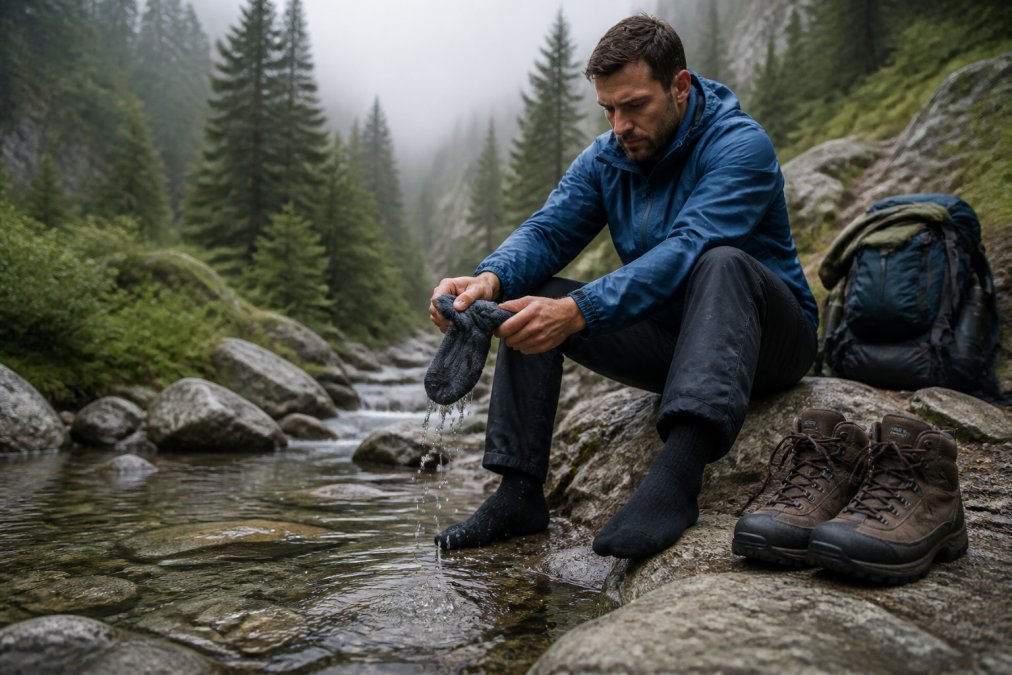
Moisture management happens at three layers: skin, sock, and shoe. Fixing only one rarely works, a waterproof membrane over a cotton sock still produces wet, cold feet, and a breathable non-waterproof shoe over a soaked synthetic sock still causes blisters. The goal is to move sweat away from skin faster than your foot produces it, and give any water that gets in a path out.
Sock System Synergy With Waterproof Membranes
A waterproof membrane slows vapor escape, so the sock layer has to do more work than in a non-waterproof shoe. The pairing matters more than the brand.
Socks Waterproof Breathable Outdoor →
- Merino wool (fine gauge, 17.5-19 micron): Wool fibers absorb up to roughly 30% of their weight in moisture vapor before feeling damp, then release it gradually. In a waterproof shoe, that buffering effect keeps skin dry during the lag between sweat production and membrane venting. Downside: wool holds water longer once fully saturated, so it dries slower than synthetics overnight.
- Synthetic (polyester, nylon, olefin): Moves liquid sweat fast and dries quickly, but has almost no vapor buffering. In a waterproof shoe on a hot day, synthetics can feel clammy because they pass sweat straight to a lining that can't vent it fast enough.
- Blends (wool + nylon + elastane): The common compromise. Wool handles vapor, nylon adds durability and dry speed, elastane holds fit. Most thru-hikers land here for three-season use.
- Cotton: Avoid. Cotton holds water against skin, loses insulation when wet, and is the single most common cause of trench foot and blisters on multi-day trips.
Maintenance and Re-Waterproofing: The Cost Competitors Skip
The waterproof premium is not a one-time purchase. DWR finishes are a wear item: abrasion from trail debris, body oils, sunscreen, and repeated washing degrade the finish, and once water stops beading, the membrane works alone, so the shoe feels wet out even though it isn't leaking.
- Rinse uppers with lukewarm water and a soft brush after every wet or muddy trip, grit abrades DWR and clogs membrane pores
- Wash with a technical footwear cleaner (not detergent or dish soap) 2-4 times per season; detergents leave residue that attracts water
- Reapply a DWR spray or wax when water stops beading, typically every 20-40 trail days, more often in abrasive terrain
- Air-dry at room temperature, stuffed with newspaper or a boot dryer on low; never on a radiator, in a dryer, or in direct sun
- Replace insoles when they stay damp or lose shape, a compressed insole holds sweat against the footbed
- Inspect seams and membrane integrity once per season; a failed seam turns a waterproof shoe into a heavy non-waterproof shoe
Matching Footwear to Terrain and Climate
Climate sets the baseline. Activity sets the tiebreaker. Two hikers in the same 45°F rain, one on a three-hour day hike, one 200 miles into a thru-hike, should not make the same footwear decision. Most guides stop at "wet = waterproof." That's the wrong resolution.
Decision Matrix by Activity
| Activity | Default choice | When to override | Why |
|---|---|---|---|
| Day hiking, 3-8 miles | Non-waterproof + waterproof socks in pack | Cold rain or snow forecast → waterproof | Short exposure, fast drying, low consequence |
| Weekend backpacking, 1-3 nights | Waterproof if wet forecast, otherwise non-waterproof | Deep crossings → non-waterproof + waterproof socks | One overnight dry window is enough for non-waterproof |
| Thru-hiking (multi-week) | Non-waterproof | Sustained cold/wet (e.g., shoulder-season long trails) → waterproof | Drying time dominates; a wet waterproof shoe may not dry for days |
| Mountaineering / alpine | Waterproof, often insulated | Warm-weather glacier travel → non-waterproof + waterproof socks | Cold + snow + crampon straps favor a sealed, stiff shoe |
| Desert / arid | Non-waterproof | Winter canyon trips with water crossings → waterproof socks | Breathability and drainage beat water protection |
| Trail running / fastpacking | Non-waterproof | Cold rain races → waterproof sock | Weight and drainage matter more than a membrane |
Why Thru-Hiking Flips the Math
On a thru-hike, the shoe is wet for hours at a time, day after day. A non-waterproof shoe with a mesh upper and minimal foam can dry overnight in a ventilated shelter or in the sun at lunch. A waterproof shoe that fills with water, over the collar, through the tongue, or via a saturated sock, may still be damp 24-48 hours later, because the membrane that kept water out now keeps it in.

Why Mountaineering Flips It Back
In alpine conditions, the calculus inverts. Cold plus wet is a hypothermia risk, not a comfort problem. The National Weather Service hypothermia guidance notes that wet clothing and footwear accelerate heat loss, and above treeline there's no dry shelter to change into. A waterproof, often insulated boot keeps liquid water out and retains warmth, and the drying-time penalty is irrelevant because you're not counting on the shoe to dry mid-trip.
The Terrain Layer
- Wet, cool, mixed (Pacific Northwest, shoulder-season, mud, snow): Waterproof earns its premium. The AdventureTrailhead men's waterproof hiking boots pair a waterproof membrane with a rubber outsole for traction on muddy and rocky ground, exactly the terrain where the premium pays off.
- Hot, dry, humid (desert, summer humidity, long dry approaches): Non-waterproof wins. Breathability and drainage beat water protection you won't use.
- Shallow stream crossings: Waterproof blocks ingress if water stays below the collar.
- Deep crossings: Neither shoe is ideal alone. Non-waterproof drains; waterproof socks provide the barrier. Gaiters reduce inflow.
- Multi-day wet trips: Waterproof plus waterproof socks gives redundancy when drying windows are short.
| Terrain / Climate | Recommended | Why |
|---|---|---|
| Cold rain, mud, snow | Waterproof | Keeps water out, retains warmth |
| Hot, humid summer | Non-waterproof | Breathes, dries fast |
| Shallow stream crossings | Waterproof | Blocks water ingress |
| Deep crossings | Non-waterproof + waterproof socks | Drains, sock handles barrier |
| Multi-day wet trips | Waterproof + waterproof socks | Redundancy when drying is limited |
| Alpine / above treeline | Waterproof + gaiters | Cold + wet is a safety issue, not comfort |
Cost-Per-Use: When Waterproof Hiking Shoes Pay Off
Cost-per-use settles this question: divide the shoe price by the days you'll actually use it in conditions where waterproofing matters.
Frequently Asked Questions
Do I really need waterproof hiking shoes?
It depends on where and when you hike. Waterproof hiking shoes earn their keep in wet climates, on trails with stream crossings, or in shoulder-season slush where water ingress is constant. In dry, hot conditions, a non-waterproof shoe dries faster and vents better. If most of your hikes involve mud, rain, or snow, waterproofing is worth it. For desert or summer day hikes, save the money.
Are waterproof trail shoes worth it for summer hiking?
Usually not. Summer heat increases sweat accumulation, and a waterproof membrane traps that moisture inside. Breathability drops, feet stay damp, and blister prevention becomes harder. Unless you expect rain or cross streams, a breathable synthetic mesh shoe with moisture-wicking socks keeps feet drier in summer. Reserve waterproof models for wet or cold conditions.
What are the main disadvantages of waterproof hiking footwear?
The biggest downsides are weight penalty, reduced breathability, slower drying time, and higher cost. Once water gets in over the collar, a waterproof shoe can take far longer to dry than a non-waterproof one. They also cost more upfront, and the DWR finish wears off, requiring re-waterproofing. For hot, dry trails, these trade-offs often outweigh the benefits.
How do I keep my feet dry while hiking if my shoes get wet?
Start with moisture-wicking socks, and consider waterproof socks as a backup layer. Drain water from your boots at breaks, wring out socks, and air-dry liners when possible. Carry spare socks in a dry bag. Gaiters reduce trail debris and water entry. Reapply DWR spray to maintain water repellency. These steps help even when your waterproofing fails.