
5 Best Lightweight Sleeping Bags for Backpacking 2026
Table of Contents
- Quick Comparison: 5 Best Lightweight Sleeping Bags for Backpacking
- How to Choose a Backpacking Sleeping Bag
- Ultralight Sleeping Bag Temperature Ratings Explained
- Down vs. Synthetic Sleeping Bag Pros and Cons
-
The 5 Best Lightweight Sleeping Bags for Backpacking in 2026
- 1. Lightweight Envelope Sleeping Bag - Warm & Cold Weather for Camping
- 2. 190×75cm Ultralight Envelope Sleeping Bag
- 3. Camping Sleeping Bag Lightweight Warm & Cold Envelope Backpacking Sleeping Bag
- 4. Portable Waterproof Emergency Survival Sleeping Bag Thermal Gear
- 5. Ultra-Light Inflatable Sleeping Pad with Built-in Pillow
- Sleeping Bag Care, Repair, and Sustainability
- Conclusion
- Frequently Asked Questions
Last Updated: September 25, 2026
Quick Comparison: 5 Best Lightweight Sleeping Bags for Backpacking
Finding the 5 best lightweight sleeping bags for backpacking comes down to matching insulation, temperature rating, and packed weight to your trip. At AdventureTrailhead, we stock envelope and ultralight options from $29.51 to $97.00. This guide covers how to choose a backpacking sleeping bag, what ultralight sleeping bag temperature ratings mean, and how down and synthetic insulation compare.
| Product | Price | Weight | Best For |
|---|---|---|---|
| Lightweight Envelope Sleeping Bag | $66.97 | 1-1.8 kg (2.2-3.9 lbs) | All-season camping |
| 190×75cm Ultralight Envelope Sleeping Bag | $79.99 | 680 g | Minimalist backpacking |
| Camping Sleeping Bag Lightweight Warm & Cold | $97.00 | 1-1.8 kg (2.2-3.9 lbs) | Four-season trips |
| Portable Waterproof Emergency Survival Bag | $29.51 | Ultralight | Emergency backup |
| Ultra-Light Inflatable Sleeping Pad | $49.99 | Compact | Sleep system comfort |
How to Choose a Backpacking Sleeping Bag
Start with the trip, not the spec sheet. A summer-weekend bag will leave you shivering on a shoulder-season climb, and a four-season bag will cook you in July.

Match the Bag to Your Trip
Envelope bags give you room to move and suit car camping, base camps, and relaxed backpacking. Mummy and quilt designs cut weight by trimming fabric, which matters on thru-hiking routes. For most three-season backpacking, an envelope bag in the 1-1.8 kg range hits a practical balance.
Weight and Packed Size
Base weight is the number that matters. A 680 g bag is a genuine ultralight pick; a 1.8 kg bag is comfortable but heavier on long carries. Packed volume matters just as much, a compression sack shrinks a bulky bag to fit a 50L pack.
Ultralight Sleeping Bag Temperature Ratings Explained
Temperature ratings are the most misunderstood spec in backpacking. A bag rated to 20°F is not comfortable at 20°F for everyone. Understanding how those numbers are produced, and where they break down, is the difference between a warm night and a miserable one.
How the EN/ISO Test Actually Works
The EN 13537 standard, now folded into the ISO 23537 series, uses a heated manikin in a base layer and socks, lying on an insulated pad inside a climate chamber. Technicians record the temperatures at which the manikin's heat loss crosses defined thresholds, producing four numbers:
- Upper limit: The warmest temperature at which a standard man can sleep without overheating.
- Comfort: The temperature at which a standard woman stays comfortable. This is the number cold sleepers should anchor to.
- Lower limit: The temperature at which a standard man stays comfortable. Warm sleepers can often push slightly below this.
- Extreme: A survival threshold, not a comfort target. At this temperature the bag is protecting you from hypothermia, not helping you sleep.
Why the Tag Number Is Not Your Number
Several factors move your personal comfort temperature by 10°F or more:
- Sleep style. Cold sleepers, often women, leaner builds, and anyone who runs cold, should buy to the comfort rating, not the lower limit. Warm sleepers can often use the lower limit.
- Pad R-value. A bag's loft compresses under your body weight, so the insulation beneath you does almost nothing, the pad does the work. A 20°F bag on an R-value 5 pad feels very different on an R-value 2 pad. For three-season backpacking, an R-value of 3 to 4 is a reasonable floor; for winter, aim for 5 or higher.
- What you wear and eat. A dry base layer, a hat, and a hot meal before bed raise your effective comfort temperature. Going to bed cold, damp, or hungry lowers it.
- Hydration and altitude. Dehydration impairs circulation, and altitude suppresses your shivering response. Both make a bag feel colder than its rating suggests.
Climate Changes the Math
Most reviews test bags in dry, cold conditions. Humidity and precipitation change performance, and this is where generic ratings fall short.
- Arid, high-altitude environments. Low humidity means your body loses heat efficiently and down keeps its loft, so the rated temperature is closest to reality here.
- Humid, wet environments. Perspiration and ambient moisture degrade loft, especially in untreated down. In sustained humidity, expect a down bag to feel 5°F to 10°F colder than its rating; consider synthetic or hydrophobic down.
- Freezing rain and snow. Shell fabric wet-out is the real risk. A water-resistant shell and a dry bag liner matter more than the rating on the tag.
A Practical Buying Rule
When comparing bags, line up the comfort ratings, not the marketing numbers. If a budget bag does not publish EN/ISO figures, assume the printed rating is closer to the extreme limit than the comfort limit. Pair any bag with an insulated pad rated for the conditions, and treat the rating as a starting point rather than a promise.
Down vs. Synthetic Sleeping Bag Pros and Cons
Down and synthetic insulation solve different problems, and the right choice depends on your climate, your pack, and how you maintain the bag. The spec sheet only tells part of the story.
How Each Insulation Actually Works
Down is the undercoating from waterfowl, clusters of fluffy filaments that trap air in tiny pockets. Its warmth comes from loft, and its efficiency is measured in fill power: the volume in cubic inches one ounce of down occupies. Higher fill power means more loft per ounce, so less weight and smaller packed size for the same warmth.
The Real Trade-Offs
- Weight-to-warmth. Down wins decisively. For the same temperature rating, a high-fill-power down bag can weigh 30% to 50% less than a comparable synthetic bag and pack to roughly half the volume.
- Moisture performance. Synthetic wins. Down loses loft when wet and dries slowly in the field. Hydrophobic down treatments slow moisture absorption but do not make down waterproof.
- Durability and loft retention. Down holds its loft for many seasons if cared for properly. Synthetic fibers gradually lose resilience and may lose noticeable warmth after a few years of heavy use.
- Cost. Synthetic is generally less expensive at the same temperature rating. High-fill-power down carries a premium for sourcing and processing.
- Repairability. A tear in a down bag can be patched, but loose down migrates through the hole until sealed. Synthetic bags shed less fiber at a tear, making field repair more forgiving.
Shell Fabric and Denier Ratings
The shell is the other half of the insulation story. Denier (D) measures yarn density, lower numbers mean finer, lighter, less abrasion-resistant fabric. A 10D or 15D shell is common on ultralight bags; 20D or 30D is more durable and slightly heavier. Ripstop weaves add a grid of thicker threads to stop tears spreading.

Sustainability and Sourcing
Where the insulation comes from matters to a growing number of backpackers. Responsible Down Standard (RDS) certification is the most widely recognized third-party verification that down was sourced without live-plucking or force-feeding. On the synthetic side, some manufacturers use recycled polyester fibers, and PFC-free DWR finishes are replacing fluorocarbon-based shell treatments.
Lightweight Envelope Sleeping Bag →
How to Decide
For dry, cold, high-altitude trips where every ounce counts, down wins on weight and packability. For humid, wet, or unpredictable conditions, and for anyone who sweats heavily, synthetic is safer. Cotton-filled envelope bags are a third category: affordable, comfortable, and best for fair-weather camping where weight and pack size are not priorities.
The 5 Best Lightweight Sleeping Bags for Backpacking in 2026
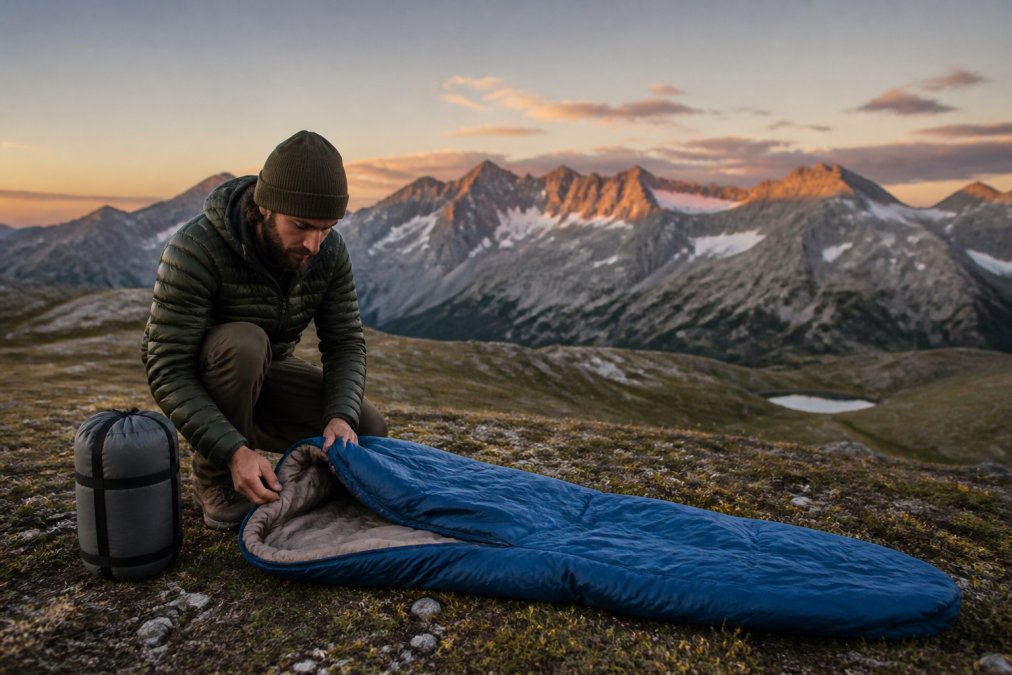
1. Lightweight Envelope Sleeping Bag - Warm & Cold Weather for Camping
Our top pick for most backpackers. The 210T anti-tear polyester shell resists snags, and the 100% cotton fill feels soft against the skin. At $66.97, it's a versatile all-season bag.
2. 190×75cm Ultralight Envelope Sleeping Bag
The lightest bag on this list at 680 g, and the one to grab for minimalist backpacking. The water-resistant nylon shell and soft polyester lining handle damp spring and autumn conditions.
3. Camping Sleeping Bag Lightweight Warm & Cold Envelope Backpacking Sleeping Bag
The four-season option. Same 210T anti-tear shell and 100% cotton fill as our top pick, but with a winter comfort range down to 0-5°C. At $97.00, it's the most capable bag here for cold trips.
4. Portable Waterproof Emergency Survival Sleeping Bag Thermal Gear
Not a primary bag, but the one you hope never to need. This waterproof Mylar thermal bag retains body heat in emergencies and packs into any emergency kit. At $29.51, it's cheap insurance for rescue, first aid, and unexpected cold.
5. Ultra-Light Inflatable Sleeping Pad with Built-in Pillow
A bag is only half your sleep system. This pad is 71 cm wide and 12 cm thick, with a built-in pillow for neck support. Inflate it with the built-in foot pump or an external valve. At $49.99, it's the comfort upgrade that makes any bag sleep warmer.
Sleeping Bag Care, Repair, and Sustainability
A well-cared-for bag lasts a decade or more. Clean it with a gentle, non-detergent wash and air-dry it fully before storage. For field repairs, carry a patch kit for shell tears and a spare zipper pull, since a snagged zipper is the most common trail failure.
Conclusion
Matching a sleeping bag to your climate, base weight, and budget takes a little homework, but the payoff is a warmer, lighter pack on every trip. Whether you need a sub-700g ultralight bag or a four-season workhorse, AdventureTrailhead carries the gear to get you there, from compression sacks to insulated pads.

Frequently Asked Questions
What are the best lightweight sleeping bags in 2026?
For 2026, the top picks depend on your priorities. The 190×75cm Ultralight Envelope Sleeping Bag at $79.99 weighs just 680g and suits minimalist backpackers. The Lightweight Envelope Sleeping Bag at $66.97 offers all-season versatility with a 210T anti-tear polyester shell. The Camping Sleeping Bag at $97.00 provides four-season coverage. For emergency backup, the Portable Waterproof Emergency Survival Sleeping Bag at $29.51 uses Mylar to retain heat. Pair any bag with the Ultra-Light Inflatable Sleeping Pad at $49.99 for full comfort.
What temperature rating do I need for a 3-season backpacking sleeping bag?
For three-season backpacking, look for a comfort rating around 20°F to 30°F. The Camping Sleeping Bag Lightweight Warm & Cold Envelope Backpacking Sleeping Bag covers spring and autumn at roughly 10°C to 20°C (50°F to 68°F) and winter at 0°C to 5°C (32°F to 41°F). The 190×75cm Ultralight Envelope Sleeping Bag handles spring, summer, and autumn. Always check whether a rating is a comfort or lower-limit figure.
How do I choose between down and synthetic insulation for backpacking?
Down insulation offers the best warmth-to-weight ratio and compresses smaller, making it ideal for ultralight backpacking. Synthetic insulation keeps you warm even when damp and dries faster, which suits wet climates. The bags in our lineup use cotton and synthetic fills that balance cost and performance. If you backpack in humid conditions or expect rain, synthetic is the safer choice. For dry, cold environments where every ounce counts, down wins.
How much should a lightweight backpacking sleeping bag weigh?
A true ultralight backpacking sleeping bag should weigh under 2 lbs (about 900g). The 190×75cm Ultralight Envelope Sleeping Bag hits 680g, making it one of the lightest options available. The Lightweight Envelope Sleeping Bag ranges from 1 kg to 1.8 kg (2.2 to 3.9 lbs), which suits backpackers who prioritize durability over minimum weight. For thru-hiking, aim for the lower end. Pair your bag with a lightweight sleeping pad to keep your total sleep system under 3 lbs.
Can I repair a sleeping bag in the field?
Yes, most sleeping bag repairs are simple with a patch kit. For rips in the shell, use a peel-and-stick nylon patch or tenacious tape. For zipper snags, apply zipper lubricant or wax. Compression sack straps can be replaced with cord. The 210T anti-tear polyester fabric on several bags resists punctures, but carrying a small repair kit adds security on multi-day trips. Proper care, including air drying and storing loosely, extends the life of any bag.