
Best Lightweight Ice Axe for Glacier Travel 2026
Table of Contents
- Quick Comparison: Top Lightweight Ice Axes for Glacier Travel
- How to Size an Ice Axe for Your Height and Climbing Style
- Weight-to-Durability Ratio: Why Lighter Isn't Always Better
- Ice Axe Self-Arrest Technique: What Makes a Lightweight Axe Effective
- B-Rated vs T-Rated Ice Axes: Which Rating for Glacier Travel
- Shaft Material: Aluminum vs Steel for Lightweight Performance
- Maintenance and Longevity: Keeping Your Lightweight Axe Sharp
- Conclusion
Last Updated: August 29, 2026
Quick Comparison: Top Lightweight Ice Axes for Glacier Travel
When planning a multi-day glacier expedition, every ounce matters. A lightweight ice axe can mean the difference between reaching your objective with energy to spare and turning back exhausted. Lighter doesn't automatically mean better, you need the right balance of weight, durability, and self-arrest capability for your terrain.
Manufacturers have learned to cut weight without sacrificing the structural integrity you need when your life depends on self-arrest. Yet many climbers still assume they must trade performance for packability. That assumption is outdated.
Here's what matters most when evaluating a lightweight ice axe for glacier travel:
| Feature | Why It Matters | What to Look For |
|---|---|---|
| Total weight | Reduces fatigue over multi-day climbs | 400-500g for technical glacier work |
| Shaft material | Affects durability and swing weight | Aluminum alloy for weight, steel pick for reliability |
| Pick geometry | Determines self-arrest effectiveness | Moderate curve with adequate penetration angle |
| Shaft length | Must match your height and climbing style | 50-70cm for glacier travel; size down for technical climbing |
| Head construction | Balance between weight savings and strength | Forged steel pick with aluminum shaft integration |
Below, we'll walk through sizing, the weight-to-durability equation, self-arrest technique, rating systems, material choices, and maintenance.
How to Size an Ice Axe for Your Height and Climbing Style
Sizing an ice axe isn't a one-size-fits-all calculation. Your height is the starting point, but your intended use changes the math entirely.
For general glacier travel, stand the axe upright on flat ground. The spike should reach somewhere between your wrist and mid-forearm when your arm hangs naturally at your side. This typically means a 50-65cm axe for climbers 5'6" to 6'2" (americanalpineclub.org). Shorter climbers should consider 45-50cm, while taller mountaineers might go 65-70cm.
If you're doing technical ice climbing, couloir work, or mixed terrain, choose a shorter axe (45-55cm) for better control when swinging at steep ice. For gentle glacier slopes with occasional steeper sections, a longer axe (60-70cm) provides better leverage for self-arrest and reduces energy per swing.
Weight distribution matters too. A lightweight ice axe should feel balanced in your hand, not tip-heavy toward the pick. When carrying it for 8 hours across undulating terrain, an unbalanced axe becomes exhausting. Test the axe in hand if possible.

Weight-to-Durability Ratio: Why Lighter Isn't Always Better
The weight-to-durability ratio is where most climbers make their mistake. They chase the lightest option and end up with an axe that fails under real-world stress.
Manufacturers cut weight through material selection and wall thickness. An aluminum shaft weighs roughly 40-50% less than steel, but aluminum fatigues faster under repeated stress (peer-reviewed research). A steel pick is heavier than titanium or composite alternatives, but it holds an edge longer and resists deformation from impact.
Aluminum shaft with steel pick (most common for glacier travel): Typically 420-480g. You get weight savings in the shaft while retaining a pick that won't dull quickly or bend on hard ice. This is the sweet spot for most climbers because the pick is where durability matters most.
Full aluminum construction: Weighs 350-420g but requires more careful maintenance. The pick dulls faster and the softer aluminum shaft can develop micro-fractures with aggressive self-arrest practice or steep ice climbing. Better for climbers using their axe primarily for crevasse rescue on gentle slopes.
Steel shaft with steel pick: Weighs 550-650g. You're carrying extra weight for minimal durability gain over aluminum-shaft designs. Most climbers skip this option.
The durability equation shifts based on use frequency and terrain. If you're doing one major glacier expedition per year on relatively gentle terrain, an aluminum axe might serve you well for five years. If you're climbing 30+ days per year on steep ice, the steel pick becomes essential.
Ice Axe Self-Arrest Technique: What Makes a Lightweight Axe Effective
Self-arrest, stopping yourself during a fall on snow or ice, is the single most critical skill for glacier travel. Your axe must be capable of arresting your slide, and your body must know exactly how to use it.
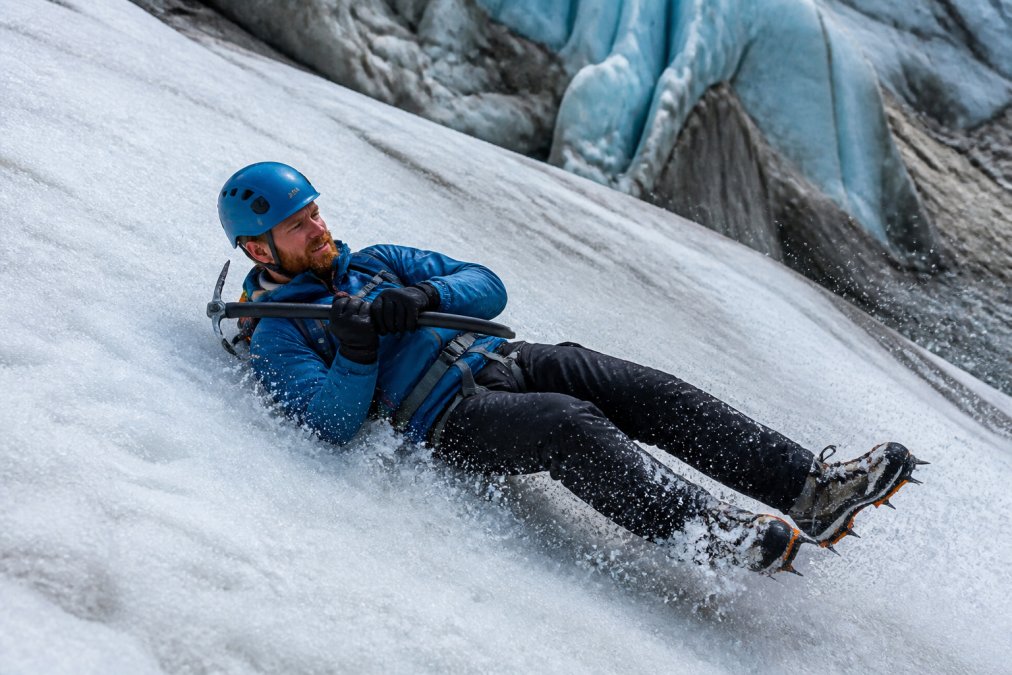
A lightweight ice axe works differently than a heavier one during arrest. The lighter weight means less momentum during a fall, so you stop faster. But it also means less force behind the pick, requiring better technique to compensate.
Effective self-arrest relies on three factors: pick geometry, shaft flexibility, and body position. A pick with moderate curve (45-55 degree angle) penetrates soft to medium snow effectively without flipping you or skidding across hard ice (americanalpineclub.org). Shaft flexibility matters more with lighter axes, a slightly flexible aluminum shaft absorbs impact energy during arrest, reducing shock load on your shoulders and wrists.
Your body position determines whether the axe works at all. During arrest, drive the pick into the snow while rolling face-down, with weight distributed across the pick and your crampons. The axe head should be held close to your shoulder, with the shaft angled across your body. Your legs stay extended behind you, crampons digging in. A lightweight axe requires slightly more aggressive body positioning.
Practice self-arrest on snow slopes at least twice per season. Muscle memory degrades, and different snow conditions change how the axe behaves. A lightweight axe demands more precision in technique, so regular practice is essential.
B-Rated vs T-Rated Ice Axes: Which Rating for Glacier Travel
Ice axes sold in the U.S. market are tested to either B-rating or T-rating standards, which determine their suitability for different climbing styles.
B-rated axes (general mountaineering or trekking axes) are tested for gentle to moderate terrain. They're designed for glacier travel, mixed terrain, and occasional steep snow climbing. Most lightweight ice axes for glacier travel fall into this category because manufacturers can save weight while meeting requirements.
T-rated axes (technical climbing axes) are tested for sustained steep ice and mixed climbing. Testing is more aggressive, and the pick and shaft must withstand harder impacts and repetitive stress. T-rated axes are typically heavier because construction is more robust.
If you're doing glacier travel with occasional couloir climbing or moderate ice slopes, a B-rated lightweight axe is appropriate and sufficient. If you're planning sustained vertical ice climbing or mixed terrain with long pitches of 60+ degree ice, you need a T-rated axe. The weight penalty is usually 50-100g, which is significant over a multi-day expedition but necessary for safety.
Examine the product description or manufacturer specs before buying. Not all lightweight options carry T-rating because weight savings come from material choices that wouldn't pass T-rating standards. This isn't a flaw, it's a design choice matching the tool to its intended use.
Shaft Material: Aluminum vs Steel for Lightweight Performance
The shaft material is where the weight-versus-durability tension becomes concrete. Aluminum and steel offer fundamentally different performance profiles.
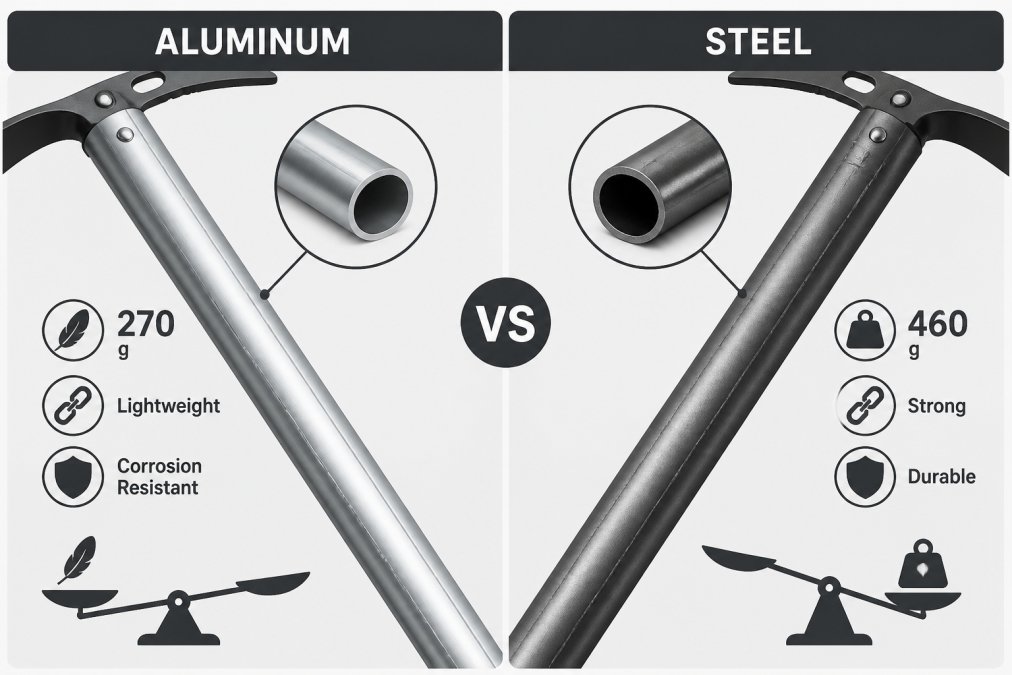
Aluminum shafts (typically 6061 or 7075 alloy) weigh 150-200g and provide the primary weight savings. Aluminum is stiff enough for self-arrest and swing control, yet flexible enough to absorb impact energy. The trade-off: aluminum fatigues over time. After 5-10 years of regular use, micro-fractures can develop, particularly where the head is attached. Aluminum also conducts cold better than steel, meaning your hand gets colder on long expeditions.
Steel shafts weigh 250-350g more than aluminum but resist fatigue indefinitely. A steel shaft will outlast you. The downside is extra weight, which accumulates over 8-10 hours of climbing. Steel also transmits impact more directly to your shoulders during self-arrest.
Most modern lightweight axes use aluminum shafts because weight savings justify the durability trade-off for typical expedition use. If you're climbing 20+ days per year or doing aggressive ice climbing, a steel shaft makes sense. If you're doing one or two expeditions per year on moderate terrain, aluminum is the right choice.
Some manufacturers offer hybrid construction with an aluminum shaft and steel reinforcement at stress points. This adds 30-50g compared to full aluminum but extends fatigue life significantly.
Maintenance and Longevity: Keeping Your Lightweight Axe Sharp
A lightweight ice axe demands regular maintenance to perform safely. The pick is your primary tool, and a dull pick is a liability.
Sharpening frequency depends on terrain and material. A steel pick on hard alpine ice needs sharpening every 3-5 days of climbing. Aluminum picks dull faster, every 2-3 days on hard ice, or every 5-7 days on moderate snow. A dull pick won't penetrate reliably during self-arrest or climbing.
Use a metal file and sharpening stone, aiming for a 45-55 degree angle on the pick face. Budget 15-20 minutes per sharpening session. Most climbers learn to sharpen their own axes because professional services are rare and expensive.
Inspect the shaft regularly for cracks, dents, or delamination. Aluminum shafts should be examined closely for micro-fractures, particularly near the head attachment. A small crack can propagate during use and cause catastrophic failure.
The spike at the base also dulls and can bend. If visibly bent or broken, have it repaired or replaced by a climbing equipment specialist.
Store your axe dry and protected. A simple cloth bag in a cool, dry place is sufficient. Some climbers apply a light coat of oil to steel picks during off-season storage.
A well-maintained lightweight ice axe will serve you for 10+ years of regular use. The pick may need replacement after 5-7 years depending on use intensity, but the shaft and head typically outlast multiple pick replacements.
Conclusion
Selecting the best lightweight ice axe for glacier travel requires balancing weight, durability, self-arrest capability, and your specific climbing style. A B-rated aluminum-shaft axe with a steel pick typically offers the best value for expedition mountaineers, providing meaningful weight savings without sacrificing durability.
At AdventureTrailhead, we recommend starting with a 55-60cm axe if you're 5'8" to 6'0" and planning moderate glacier travel. Pair it with complementary gear like our Full Body Climbing Harness with Multi D Ring Support ($118.00) for secure rope work, and our Outdoor climbing rope 10M ($39.01) for crevasse rescue and rappelling. These tools work together to create a complete, integrated system for safe alpine climbing.


The real differentiator isn't the axe itself, it's your commitment to skill development and maintenance. Practice self-arrest regularly, sharpen your pick before every expedition, and inspect your gear for fatigue damage. A lightweight ice axe is only as safe as the climber holding it.
Frequently Asked Questions
Q: What is the best ice axe for glacier travel?
A: The best lightweight ice axe for glacier travel balances weight reduction with reliable self-arrest capability and durability. Look for models with aluminum shafts (typically 1.5-2 lbs), tapered designs that reduce swing weight, and pick angles between 55-65 degrees for efficient snow penetration. Your choice depends on your height, technical skill level, and whether you're doing ski touring or steeper couloir climbing.
Q: How do I determine the correct ice axe length for my height?
A: A properly sized ice axe should reach your wrist when your arm hangs at your side. Most adults between 5'6" and 6'2" use 60-70 cm axes; shorter climbers may prefer 55-60 cm, while taller mountaineers often go 70-75 cm. Trekking axes are longer (70-90 cm) for hiking support, while technical climbing axes are shorter (50-65 cm) for steep terrain. Always test the axe in person if possible, wrist-to-ground measurement is the most reliable sizing method.
Q: Are lightweight ice axes safe for self-arrest?
A: Yes, lightweight ice axes are safe for self-arrest if they have proper pick geometry, adequate spike length, and an ergonomic grip. The key is technique, not weight, a 1.5 lb aluminum-shaft axe with a 55-60 degree pick angle will arrest a fall just as effectively as a heavier steel model if you execute the self-arrest correctly. What matters most is practicing the technique regularly and choosing an axe with a pick that bites cleanly into ice and snow. Lighter axes actually improve control during self-arrest because they require less force to position correctly.
Q: Do I need a B-rated or T-rated ice axe for glacier travel?
A: For glacier travel, a B-rated (general mountaineering) ice axe is the standard choice. B-rated axes are designed for moderate alpine terrain, glacier traverses, and mixed climbing where you're not on vertical ice constantly. T-rated (technical) axes are for steep ice climbing and couloirs where you're swinging hard and need maximum penetration. If you're doing ski touring or gentle glacier approaches, a lightweight B-rated axe is sufficient and more versatile. T-rated axes are heavier and overkill for most glacier travel scenarios.
Q: What features should I look for in a lightweight glacier travel ice axe?
A: Prioritize aluminum shaft construction (saves 0.5-1 lb compared to steel), a tapered design to reduce swing weight, a pick angle between 55-65 degrees for snow efficiency, and a comfortable ergonomic grip. Check for a leash attachment point for security, a sharp adze for step-cutting, and a long spike for self-arrest. Weight should be in the 1.3-2 lb range; anything heavier defeats the purpose of a lightweight axe for multi-day glacier expeditions.
Choosing the right gear is the foundation of safe mountaineering. AdventureTrailhead carries a full range of climbing and mountaineering equipment designed for expeditions where reliability matters. Explore our selection of helmets, harnesses, ropes, and specialized climbing gear, everything you need to climb with confidence in alpine terrain.
This article was written using GrandRanker